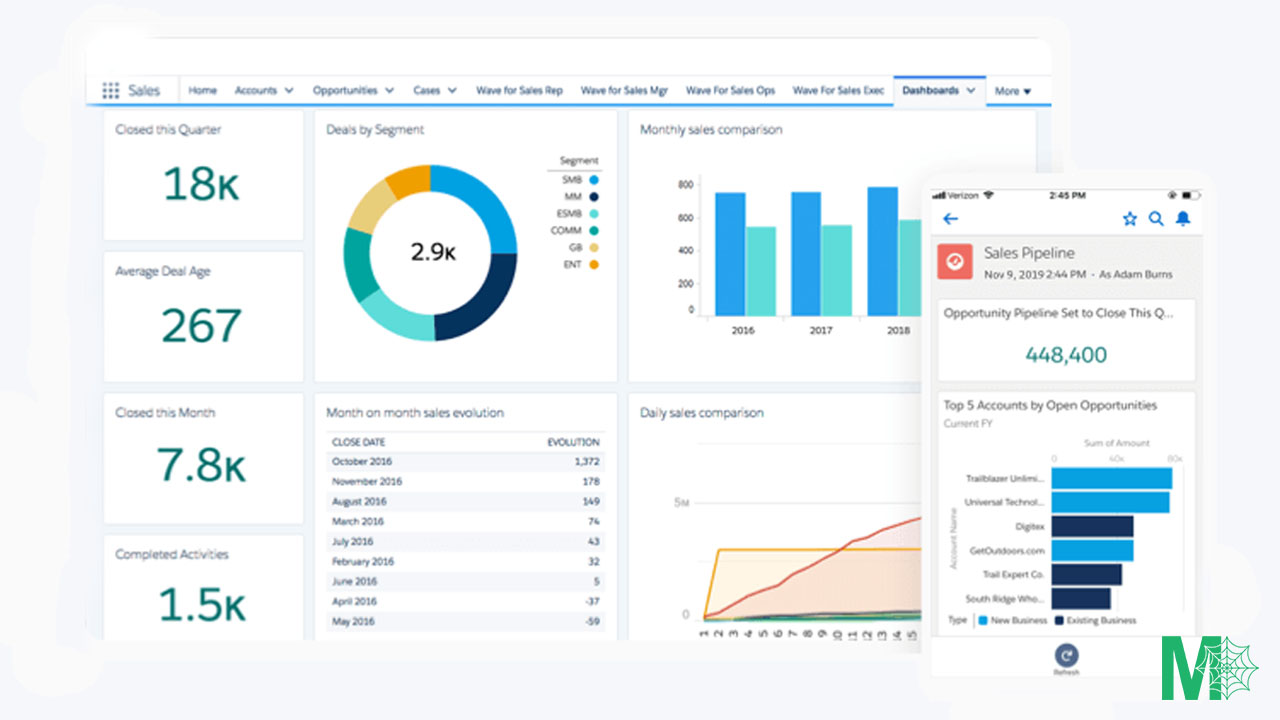
Apple, Microsoft, Starbucks, Toyota, and Alibaba all started as small and medium-sized enterprises. In their early years, they were not global powerhouses with unlimited capital or massive teams.
On the contrary, they were small groups making deliberate decisions, learning from their numbers, and adjusting quickly to what the market was telling them.
What stands out when you examine credible company histories, founder interviews, and business case studies, you will come to the realization that discipline beats almost everything including luck, strategy and capital.
In the contemporary business environment, one recurring discipline across growing SMEs is structured sales tracking.
And take note, we not talking of just knowing total revenue, but rather, understanding how sales happen, where they come from, and why some efforts work well compared to others and why some totally fail.
Many small businesses underestimate this. Sales tracking is often reduced to a daily total or a monthly figure. Many businesses people within the SME category do not fully exploit the potential of data.
The truth is, businesses that grow consistently treat sales data as feedback.
For them, however small a business can be, lets say a salon, fruit vendor or even taxi business, data informs decisions, exposes inefficiencies, and guides expansion. That is where sales tracking software becomes essential and not optional especially in 2026 and the years to follow when AI has made things very easy.
The Significance of Sales Tracking for Small Businesses
SMEs operate with limited margins for error. This is different when comparing to large corporations. For small to medium businesses, they are not at the mercy of absorbing repeated mistakes, wasted effort, or poor planning.
Every decision matters, be it pricing, inventory, staffing, and marketing carries weight.
Without structured sales tracking, business owners often rely on memory, assumptions, or scattered records which is very risky.
Using such backward methods makes it difficult to identify trends, predict revenue, or understand customer behavior.
What you ought to know is that over time, decisions become reactive rather than intentional.
Sales tracking software introduces clarity and structure into daily operations. It replaces guesswork with visible data, allowing business owners to make decisions based on what is actually happening, not what they think is happening. The section below outlines nine advantages of using a sales tracking software for your small business.
1. Sales Tracking as a Decision-Making Tool
A sales tracker is not simply a record-keeping system. Used correctly, it becomes a decision-making tool. This distinction matters, especially for small businesses.
Instead of asking, “How much did we sell last month?” the better questions become:
- Which products or services are driving revenue?
- Where are customers dropping off in the sales process?
- Which days, channels, or staff perform best?
- What patterns repeat over time?
These are questions that spreadsheets and notebooks struggle to answer consistently.
2. Clear Sales Visibility and Reliable Forecasting
One of the biggest challenges SMEs face is uncertainty. When revenue feels unpredictable, planning becomes stressful and often inaccurate.
Sales tracking software provides visibility into the sales pipeline. Business owners can see what stage each sale is in, whether it is a call, a meeting, a walk-in customer, or a completed transaction. This makes it possible to forecast revenue with more confidence.
Rather than reacting to surprises, businesses can anticipate slow periods, prepare for high-demand seasons, and make adjustments early. Over time, this stability supports healthier cash flow and smarter planning.
3. Deeper Understanding of Customers and Buying Behavior
Sales tracking goes beyond totals. It reveals patterns in customer behavior.
Over time, sales data shows:
- Who your repeat customers are
- What they buy most often
- Which products perform well and which do not
- How pricing and timing affect conversions
This insight allows small businesses to refine their offerings, improve pricing strategies, and create better customer experiences. When customers feel understood, trust grows, and repeat business becomes more likely.
4. Improved Efficiency and Sales Productivity
Manual sales tracking takes time and often leads to incomplete or inaccurate records. Important details get lost, and reporting becomes a chore.
Sales tracking software automates this process. Transactions are recorded consistently, reports are generated automatically, and data is stored in one place. This reduces administrative work and frees up time for activities that actually generate revenue.
Clear targets, visible progress, and structured workflows naturally improve accountability and productivity, even in very small teams.
5. Real-Time Insight and Faster Decisions
Waiting until the end of the month to review sales performance often means missed opportunities. By the time issues are visible, they have already affected revenue.
Sales tracking software provides real-time insight. Business owners can see performance as it happens and respond quickly. If a product is underperforming, adjustments can be made immediately. If demand increases, inventory or staffing decisions can follow without delay.
Faster access to accurate information leads to faster, better decisions.
6. Better Team Alignment and Transparency
For SMEs with employees or sales representatives, centralized sales tracking creates transparency. Everyone works from the same data, reducing confusion and miscommunication.
Managers can monitor performance fairly, identify strengths and gaps, and support team members where needed. For service-based businesses, this also simplifies commission calculations and performance reviews, building trust and motivation within the team.
7. Smarter Use of Resources and Lower Costs
Sales data highlights what works and what does not. When business owners understand which products, services, or customers generate the most value, resource allocation becomes clearer.
Time, money, and effort can be focused on high-performing areas while unnecessary costs are reduced. This improves profitability without adding complexity to operations.
8. Sustainable Growth Through Better Conversions
Sales tracking makes it easier to identify where potential customers drop off in the sales process. Even small improvements in conversion rates can have a meaningful impact on revenue.
More importantly, growth becomes intentional. Instead of expanding blindly, businesses grow based on real performance data and proven demand.
9. Moving Beyond Books and Spreadsheets
Many small businesses still rely on notebooks or basic spreadsheets. While this may work in the earliest stages, it limits visibility and increases the risk of errors.
Modern sales tracking tools automatically visualize data, highlight trends, and reduce manual effort. Most are affordable and accessible, especially when compared to the cost of missed opportunities, poor planning, and slow growth.
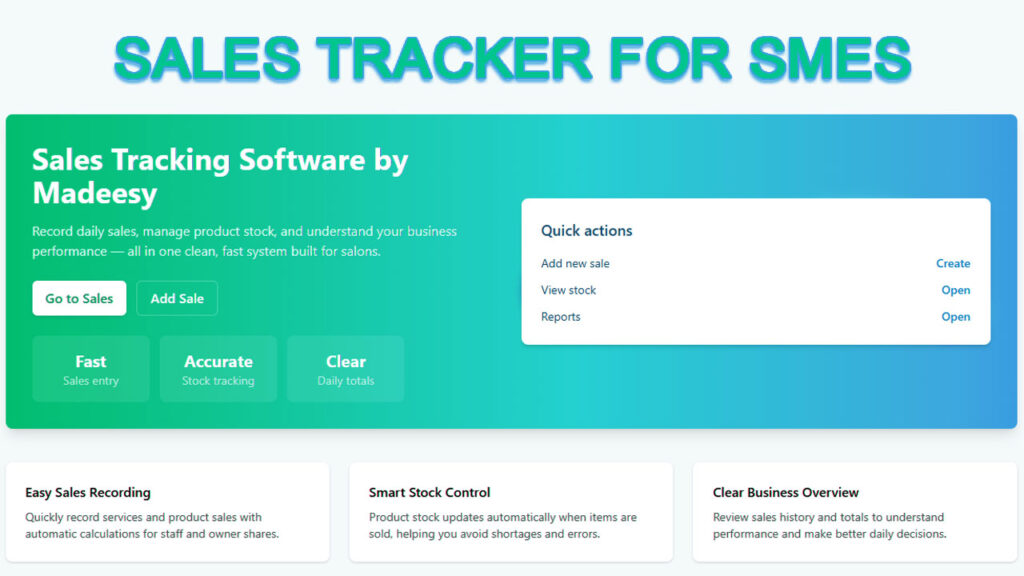
Some platforms, such as Madeesy sales tracking , offer structured ways to view daily, weekly, and monthly sales performance in one place. These tools are best understood not as software purchases, but as systems that support better decision-making.
Final Thoughts
Sales tracking is not about chasing numbers. It is about understanding how your business works.
SMEs that adopt sales tracking software gain clarity, control, and confidence. They make fewer assumptions, respond faster to change, and build growth on real insight rather than instinct alone.
For small businesses with long-term ambitions, sales tracking is not an upgrade. It is a foundation.
Leave a Reply