
In 2026, competition in the business landscape is increasing faster than ever, largely driven by artificial intelligence and automation. Tasks that once took hours can now be done in minutes, and businesses that adapt quickly are the ones that are most likely going to survive and grow.
For small and medium enterprises, speed is no longer optional. Managing customer relationships, tracking finances, and handling daily operations is becoming more demanding, especially for businesses that still rely on manual processes.
This is why automation has become a game changer. It’s no longer reserved for large corporations. Small businesses that embrace automation can save time, reduce costs, and compete effectively while scaling their operations.
What is Business Automation?
Business automation is the use technology to perform repetitive tasks and processes with minimal human intervention.
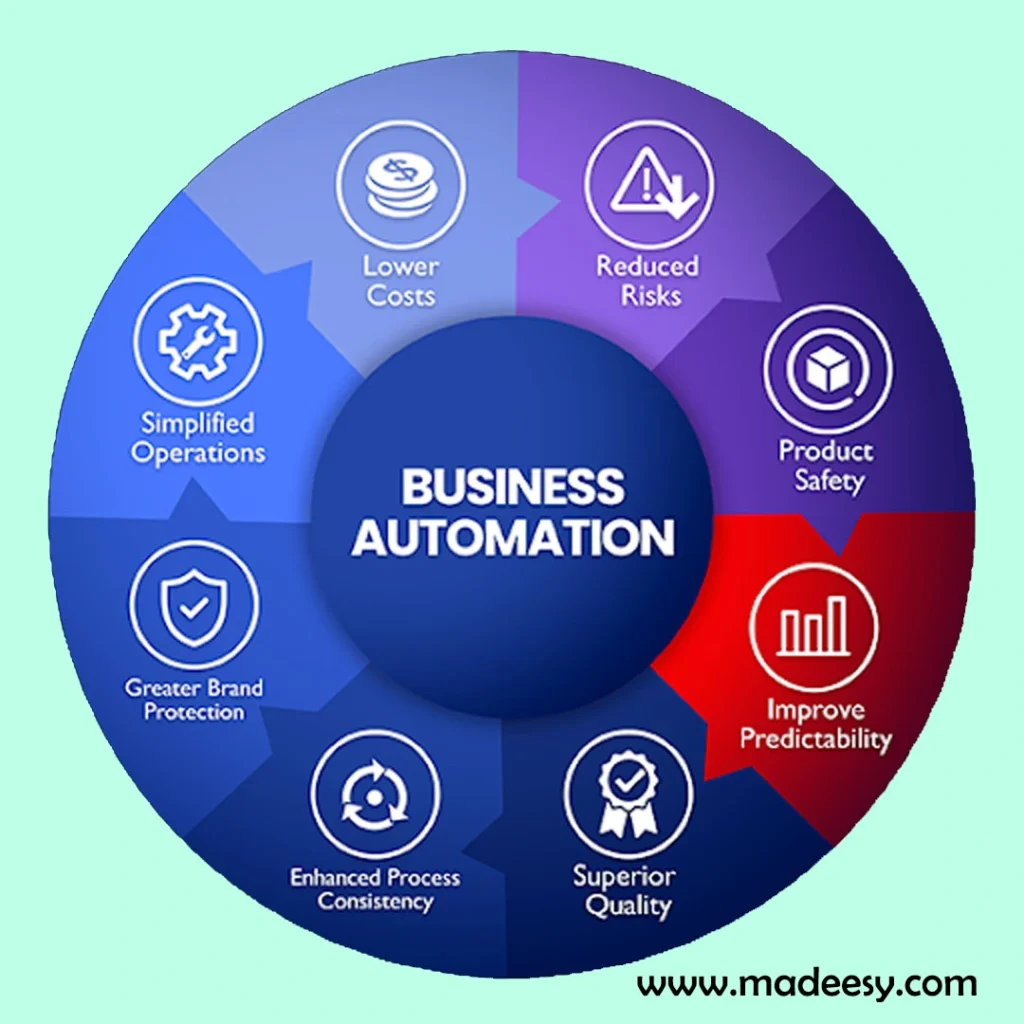
According to research sourced from Expensify, business automation can range from simple email scheduling to complex workflow management across multiple platforms.
The goal for using automation systems in any business is usually to avoid or eliminate repetitive tasks so that you or your team can focus on strategic activities that actually drive growth.
In the following sections, we will explore the advantages that automation has on business, and especially for small to medium enterprises (SMEs).
How Automation Compoundly Saves Time
When you here about business automation, the first thing that comes to mind is technology and closely follows time saving.
When you employ automation in your business, however small, you are guaranteed that you will save a lot of time and well, time is money so you get to save money too.
Saving time is the most important advantage that comes with automation. A study conducted by Rippling shows that the average entrepreneur dedicates up to 16 hours weekly to repetitive processes.
Question is, why spend two full working days doing the same thing that you could just automate and spend those 48 hours doing something else.
It’s time to start automating and focusing your energy on developing new products, building customer relationships, and planning for growth, because sooner or later, your business will need scaling.
Consider social media management alone. It’s okay to post your own Instagram posts, but that does not apply for your business, when you running a business, the business does not care whether you are bored, sick or busy, you need your content posted at scheduled intervals daily.
It is for this reason that it’s important to integrate automation in running SMEs.
Companies implementing automation tools for posting content and managing ads can save more than six hours per week, according to research from Unmudl. That’s over 300 hours annually that your team can redirect toward strategy and innovation.
A Practical Automation Example for Service-Based Businesses
A good example of simple automation is sales tracking, especially for service-based businesses like salons and nail studios. We’ve built a simple sales tracker that we’re offering completely free.
Instead of writing daily sales in notebooks, the tool lets you record everything digitally in one place.
It automatically calculates your profit, tracks how many clients you’ve served, monitors expenses, shows remaining stock, and gives you a clear picture of how the business is actually performing.
It’s designed to save time, reduce errors, and help you understand your numbers without needing accounting skills.
You can try the sales tracker today, and if it helps your business, feel free to share your feedback with us or with other business owners who might benefit from it.
Cost Reduction and Financial Impact
The financial benefits of automation are compelling. According to MHC Automation, small businesses that make the switch to automation save money in the long run.
From their study, automation is a game change in any operations of a business whether it’s automating accounting, employee onboarding, or inventory management.
Yes, it’s true that there is an upfront cost that will be needed for you to implement these automation tools, however, since you are a business owner then you clearly know that for you to improve your business you have to spend also.
What you should know is that the amount of money you will use integrating these automation tools will be nothing compared to the return on investment that you are going to get.
In a study conducted by the Data Science Central, it was discovered that small businesses lose over $600 billion each year due to human error.
Their findings revealed that automation dramatically reduces these costly mistakes. For example, automated invoice processing ensures accuracy that manual data entry simply can’t match.
To put this in context, companies like Uber have saved $170,000 in employee hours by automating expense tracking, as reported by Systems and Teams.
The scale of savings depends on your investment level. According to research from North Carolina Central University, companies with significant automation investments averaged a 17% reduction in costs versus only 7% for those with smaller investments.
How Automation Improves Accuracy and Consistency
Manual processes are prone to errors. When employees handle repetitive tasks, quality can vary based on who’s doing the work and how they’re feeling that day.
Automation ensures tasks are done the same way, every time, by every person. This consistency is crucial for maintaining standards and building customer trust.
Bill.com reports that automation improves accuracy and helps businesses stay current with evolving regulations.
Financial automation software uses internal controls to assign specific roles and permissions, creating a clear separation of duties that protects your business from fraud and compliance issues.
Empowering Your Team with Automation

Contrary to concerns about job displacement, automation actually makes employees happier.
According to research from PartnerStack, 89% of automation users feel more satisfied with their jobs, and 84% feel more satisfied with their company.
This is because automation eliminates the mind-numbing, repetitive work and frees people to focus on tasks that require creativity and critical thinking.
When your accounting team isn’t buried in data entry, they can focus on financial analysis.
When your sales team isn’t manually updating spreadsheets, they can spend time building relationships with prospects. This shift in focus leads to higher engagement and better results.
Competitive Advantage
Small businesses often lack the resources of large corporations. But automation levels the playing field. According to ActiveCampaign’s research, 88% of small companies say automation enables them to compete with big businesses. Automation is no longer optional—it’s a competitive necessity.
The statistics back this up. Nearly 80% of top-performing companies have used marketing automation for more than two years, according to research firm Gleanster.
Businesses that adopt automation early gain a significant advantage over competitors still relying on manual processes.
Scaling Without Proportional Cost Increases
One of automation’s most powerful features is its scalability. As your business grows, you can expand your automation without proportional increases in costs.
Impact reports that this is a massive benefit, allowing businesses to be as agile as possible by quickly and efficiently scaling up or down depending on seasonal demands or consistent growth.
This scalability means you’ll never outgrow your automation solution, and you won’t be forced to pay for software capacity you don’t need. Your automation grows with you.
Getting Started with Automation
The beauty of modern automation is that you don’t need a massive tech stack or huge budget to begin.
Good news is that most of these tools have free tier which often enough for small businesses, however, after trying and seeing the benefits, it will be up to you now to consider upgrading for a paid version.
Some of the reputable automation tools are Zapier, HubSpot, QuickBooks, and Mailchimp.
All these offer affordable solutions designed specifically for small businesses and they have free tiers or trial periods that let you test their effectiveness and efficiency before committing for paid version.
The key is to start small. Focus on one or two time-consuming tasks, choose a simple tool, and automate that. Small changes lead to big results. As you see success, you can expand your automation efforts to other areas of your business.
Let’s Wrap This Up
Summing up, automation is no longer a luxury but rather a strategic necessity for modern small businesses.
With automation, the time and money you get to save, improved accuracy and competitive advantages are too significant to ignore especially in 2026 as technology continues to grow rapidly.
Whether you’re managing a growing team or running a solo operation, the right automation tools can transform how you work, freeing you to focus on what truly matters which is growing your business and delighting your customers.
Leave a Reply