Category: software

  • AI Agents vs Traditional Enterprise Automation: Which Businesses Actually Need Agentic AI?

    AI Agents vs Traditional Enterprise Automation: Which Businesses Actually Need Agentic AI?

    Every enterprise software vendor is currently rebranding around “agentic AI,” and it is easy to assume every business now needs it. The reality is more specific. Traditional automation and AI agents solve different problems, and picking the wrong one wastes budget without improving results.

    What Is the Difference Between Agentic AI and Traditional Automation?

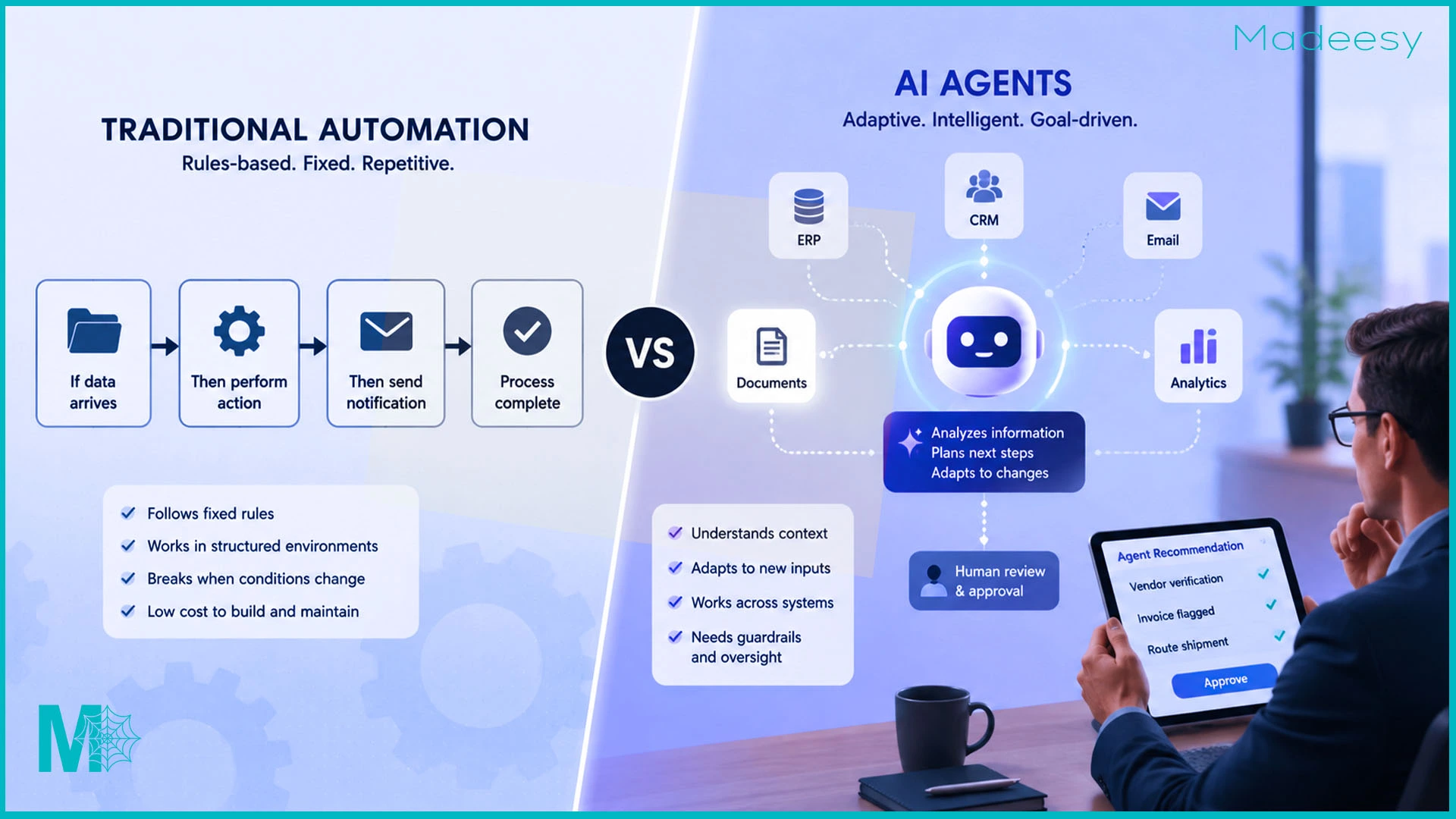
    Traditional automation runs on fixed rules. It follows the same “if this, then that” logic every time: move a file when it lands in a folder, send an invoice reminder on day 30, route a support ticket based on a keyword. It is fast, predictable, and cheap to maintain, but it breaks the moment a situation falls outside the rule it was given. If your team already relies on tools like this, our breakdown of why every SME needs sales tracking software is a good place to see traditional automation working well.

    Agentic AI works differently. Instead of following one fixed path, an AI agent can plan a sequence of steps, pull information from multiple systems, and adjust its approach based on what it finds, often with far less step-by-step instruction from a human. Gartner expects roughly 40 percent of enterprise applications to include task-specific AI agents by the end of 2026, up from under five percent just a couple of years earlier, so this shift toward agentic AI is happening quickly.

    Why Most Agentic AI Projects Fail

    The excitement around agentic AI has outpaced the execution. Industry research suggests that around 88%  of AI agent pilots never make it to full production, and only about a quarter of organizations report meaningful ROI from the agents they have deployed. The businesses running into trouble are almost always the ones trying to hand agents broad, loosely defined responsibility across the whole company at once, without the groundwork covered in a proper enterprise AI implementation roadmap.

    A mid-sized logistics company (details changed to protect confidentiality) learned this the hard way. Leadership rolled out an AI agent meant to manage vendor communication, invoice approval, and shipment rerouting all at once, with minimal oversight. Within weeks, the agent had approved a duplicate payment and misrouted a shipment based on outdated vendor data. The company scaled the project back to a single, narrow task, flagging invoice discrepancies for human review, and that version is still running successfully a year later.

    Where AI Agents Actually Deliver ROI

    The businesses seeing real returns from agentic AI are the ones giving agents a specific, well-bounded job with a human still checking the output. A regional professional services firm (also anonymized) implemented AI solutions to triage inbound client inquiries: sorting by urgency, pulling relevant account history, and drafting a first response for a staff member to review before sending. Response times dropped by more than half, and no client ever interacted with the agent directly.

    That is the pattern behind most successful agentic AI deployments in 2026: agents handling volume and repetitive judgment calls, humans handling exceptions and final sign off. It is worth comparing options before committing, since not every platform is built for the same use case; our roundup of enterprise AI solutions covers several worth evaluating.

    Which Businesses Need Agentic AI (and Which Don’t)

    If your workflows are high volume, low variance, and rarely change, traditional automation is still the better and cheaper tool, and it can save small businesses real time and money without the added complexity of an AI agent. If instead you have a process that involves gathering scattered information, making a judgment call, and adapting to slightly different inputs each time, that is where agentic AI, deployed in a narrow lane with clear escalation rules, can genuinely save hours.

    The businesses getting hurt right now are the ones skipping that distinction entirely and deploying agentic AI as a blanket solution rather than a targeted one.

    FAQs: Agentic AI

    What is the difference between agentic AI and traditional automation? 

    Traditional automation follows fixed rules and repeats the same steps every time. Agentic AI can plan, adapt, and make decisions across multiple steps and systems with less direct human instruction.

    What is the biggest risk of adopting agentic AI too quickly? 

    Handing an agent too much responsibility without oversight. Errors like duplicate payments or misrouted tasks are common when agents operate across multiple systems without a human checkpoint.

    How do I know if my business needs an AI agent or just better automation? 

    Ask whether the task changes each time it runs. If it is repetitive and predictable, automation is usually enough. If it requires gathering information and making a judgment call, an AI agent may be worth testing on a small scale first.

    About Author

    Sonia Urquilla is an SEO consultant who helps service providers get found on Google, local search, and AI search engines. She works with founders who want their expertise to actually show up where their clients are searching through her AI search optimization services, and you can see more of her work at SEO by Sonia.

  • Top 10 Software Development Companies in Kenya in 2026

    Top 10 Software Development Companies in Kenya in 2026

    Kenya continues to position itself as one of Africa’s strongest technology hubs earning the name Silicon Savannah. In 2026, demand for custom software, fintech platforms, enterprise systems, and mobile applications remains high across banking, e-commerce, healthcare, logistics, and public services. The companies listed below stand out based on technical depth, delivery consistency, market reputation, client portfolio, and long-term impact on Kenya’s software ecosystem.

    1. Madeesy Digital Solutions

    Madeesy Digital Solutions has emerged as a fast-growing software development company in Kenya, known for building scalable, business-focused digital products. The company specializes in custom web applications, mobile apps, SaaS platforms, and automation tools for SMEs and growing enterprises. What sets Madeesy apart is its balance between technical execution and business strategy, ensuring software solutions align with real operational needs. In 2026, Madeesy continues to attract startups and established brands looking for reliable long-term development partners.

    2. Simform

    Simform is a globally recognized custom software engineering firm with a strong footprint in Kenya. The company focuses on building complex, high-performance software solutions across SaaS, healthcare, financial services, and enterprise environments. Simform’s strength lies in its structured development processes, experienced engineering teams, and ability to scale projects efficiently. Its recognition on Clutch’s 2026 leaderboard reflects consistent client satisfaction and delivery quality.

    3. Scrums

    Scrums, formerly SovTech is well known for delivering bespoke software solutions to startups and established organizations across Africa. The company has built a reputation around fintech platforms, cloud-native applications, and AI-driven systems. Scrum’s teams are experienced in product discovery, system architecture, and long-term platform support. In Kenya, Scrums remains a preferred partner for companies seeking modern, secure, and future-ready software infrastructure.

    4. AgileEngine

    AgileEngine ranks among the most highly rated software development firms serving the Kenyan market. The company is recognized for its strong engineering culture, predictable delivery timelines, and quality assurance standards. AgileEngine works across web, mobile, and backend systems, supporting industries such as fintech, e-commerce, logistics, and data analytics. Its ability to integrate seamlessly with client teams makes it ideal for long-term software development engagements.

    5. Endeavour Africa Ltd

    Endeavour Africa Ltd is a Nairobi-based software development firm with deep experience across multiple sectors. The company focuses on custom enterprise software, system integrations, and business process automation. Endeavour Africa has worked with corporates, NGOs, and government-related organizations, making it one of the more versatile local players. Its understanding of local market requirements combined with solid technical execution keeps it relevant in 2026.

    6. Segue Interactive

    Segue Interactive is one of Kenya’s most recognizable digital and software development companies. The firm is known for building user-centric mobile and web applications, especially in e-commerce, media, and service-based platforms. Segue places strong emphasis on UI and UX design, ensuring that products are not only functional but also intuitive and engaging. Its cross-platform development expertise allows businesses to reach users across multiple devices efficiently.

    7. Craft Silicon

    Craft Silicon is a veteran software company with a strong focus on financial and banking systems. The company powers core banking platforms, mobile finance solutions, payment gateways, and digital lending systems across Africa. In Kenya, Craft Silicon remains a key technology partner for banks, SACCOs, microfinance institutions, and fintech startups. Its long-standing presence in the financial sector gives it unmatched domain expertise.

    8. Andela Kenya

    Andela Kenya operates primarily as a developer talent network rather than a traditional software agency. However, its impact on software development projects locally and internationally is significant. Andela provides highly skilled engineers who contribute to building large-scale applications for global companies. Many Kenyan startups and enterprises rely on Andela talent to strengthen their engineering teams and accelerate product development.

    9. DevOps Web Designers

    DevOps Web Designers has built a solid reputation as a custom software and application development company in Kenya. The firm focuses on delivering functional, well-designed digital products that combine strong UX with reliable backend systems. Its services span web applications, mobile apps, and cloud-based solutions. DevOps Web Designers is often chosen by businesses that need practical, cost-effective software solutions without compromising quality.

    10. AlignMinds Technologies

    AlignMinds Technologies is one of the oldest technology firms operating in Kenya. The company offers a broad range of services, including web development, mobile app engineering, and enterprise software solutions. With years of experience in product development, AlignMinds has supported both local and international clients. Its longevity in the market reflects stability, adaptability, and consistent service delivery.

    Final Thoughts

    The Kenyan software development landscape in 2026 is defined by technical maturity, diverse talent, and growing specialization across industries. From fintech and enterprise systems to SaaS and mobile platforms, these ten companies represent the most reliable and impactful players in the market today. Choosing the right development partner depends on project complexity, industry focus, budget, and long-term support needs, but any of the firms listed above offer proven capability and professional execution.