Every enterprise software vendor is currently rebranding around “agentic AI,” and it is easy to assume every business now needs it. The reality is more specific. Traditional automation and AI agents solve different problems, and picking the wrong one wastes budget without improving results.
What Is the Difference Between Agentic AI and Traditional Automation?
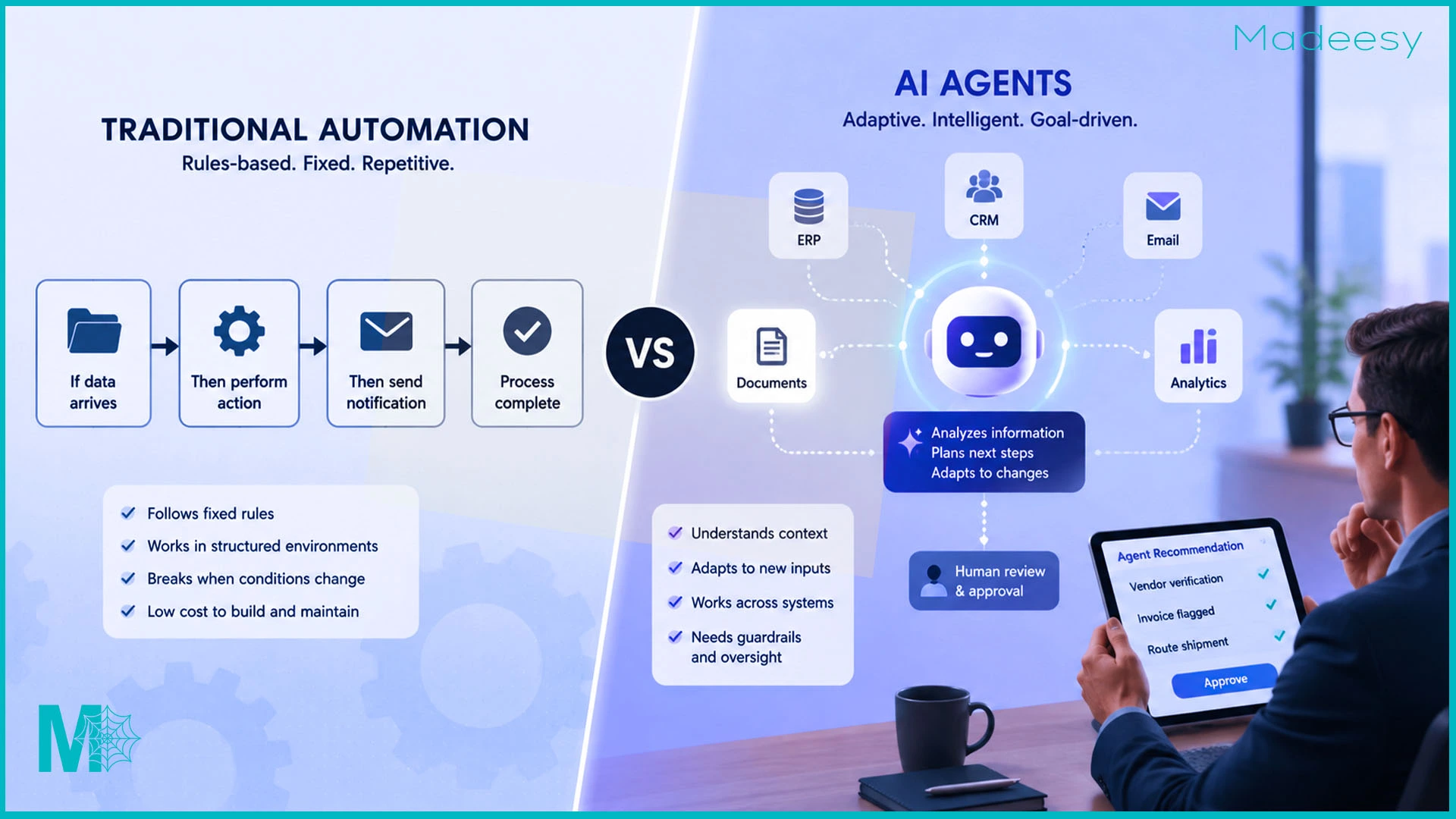
Traditional automation runs on fixed rules. It follows the same “if this, then that” logic every time: move a file when it lands in a folder, send an invoice reminder on day 30, route a support ticket based on a keyword. It is fast, predictable, and cheap to maintain, but it breaks the moment a situation falls outside the rule it was given. If your team already relies on tools like this, our breakdown of why every SME needs sales tracking software is a good place to see traditional automation working well.
Agentic AI works differently. Instead of following one fixed path, an AI agent can plan a sequence of steps, pull information from multiple systems, and adjust its approach based on what it finds, often with far less step-by-step instruction from a human. Gartner expects roughly 40 percent of enterprise applications to include task-specific AI agents by the end of 2026, up from under five percent just a couple of years earlier, so this shift toward agentic AI is happening quickly.
Why Most Agentic AI Projects Fail
The excitement around agentic AI has outpaced the execution. Industry research suggests that around 88% of AI agent pilots never make it to full production, and only about a quarter of organizations report meaningful ROI from the agents they have deployed. The businesses running into trouble are almost always the ones trying to hand agents broad, loosely defined responsibility across the whole company at once, without the groundwork covered in a proper enterprise AI implementation roadmap.
A mid-sized logistics company (details changed to protect confidentiality) learned this the hard way. Leadership rolled out an AI agent meant to manage vendor communication, invoice approval, and shipment rerouting all at once, with minimal oversight. Within weeks, the agent had approved a duplicate payment and misrouted a shipment based on outdated vendor data. The company scaled the project back to a single, narrow task, flagging invoice discrepancies for human review, and that version is still running successfully a year later.
Where AI Agents Actually Deliver ROI
The businesses seeing real returns from agentic AI are the ones giving agents a specific, well-bounded job with a human still checking the output. A regional professional services firm (also anonymized) implemented AI solutions to triage inbound client inquiries: sorting by urgency, pulling relevant account history, and drafting a first response for a staff member to review before sending. Response times dropped by more than half, and no client ever interacted with the agent directly.
That is the pattern behind most successful agentic AI deployments in 2026: agents handling volume and repetitive judgment calls, humans handling exceptions and final sign off. It is worth comparing options before committing, since not every platform is built for the same use case; our roundup of enterprise AI solutions covers several worth evaluating.
Which Businesses Need Agentic AI (and Which Don’t)
If your workflows are high volume, low variance, and rarely change, traditional automation is still the better and cheaper tool, and it can save small businesses real time and money without the added complexity of an AI agent. If instead you have a process that involves gathering scattered information, making a judgment call, and adapting to slightly different inputs each time, that is where agentic AI, deployed in a narrow lane with clear escalation rules, can genuinely save hours.
The businesses getting hurt right now are the ones skipping that distinction entirely and deploying agentic AI as a blanket solution rather than a targeted one.
FAQs: Agentic AI
What is the difference between agentic AI and traditional automation?
Traditional automation follows fixed rules and repeats the same steps every time. Agentic AI can plan, adapt, and make decisions across multiple steps and systems with less direct human instruction.
What is the biggest risk of adopting agentic AI too quickly?
Handing an agent too much responsibility without oversight. Errors like duplicate payments or misrouted tasks are common when agents operate across multiple systems without a human checkpoint.
How do I know if my business needs an AI agent or just better automation?
Ask whether the task changes each time it runs. If it is repetitive and predictable, automation is usually enough. If it requires gathering information and making a judgment call, an AI agent may be worth testing on a small scale first.
About Author
Sonia Urquilla is an SEO consultant who helps service providers get found on Google, local search, and AI search engines. She works with founders who want their expertise to actually show up where their clients are searching through her AI search optimization services, and you can see more of her work at SEO by Sonia.
Most small business content still starts with a keyword tool. Someone types a broad topic into a search bar, skims a list of suggested phrases, and picks whichever one has decent volume and low competition. It is a reasonable process, but it produces content that reads like it was built for a search engine rather than for a person, because it was.
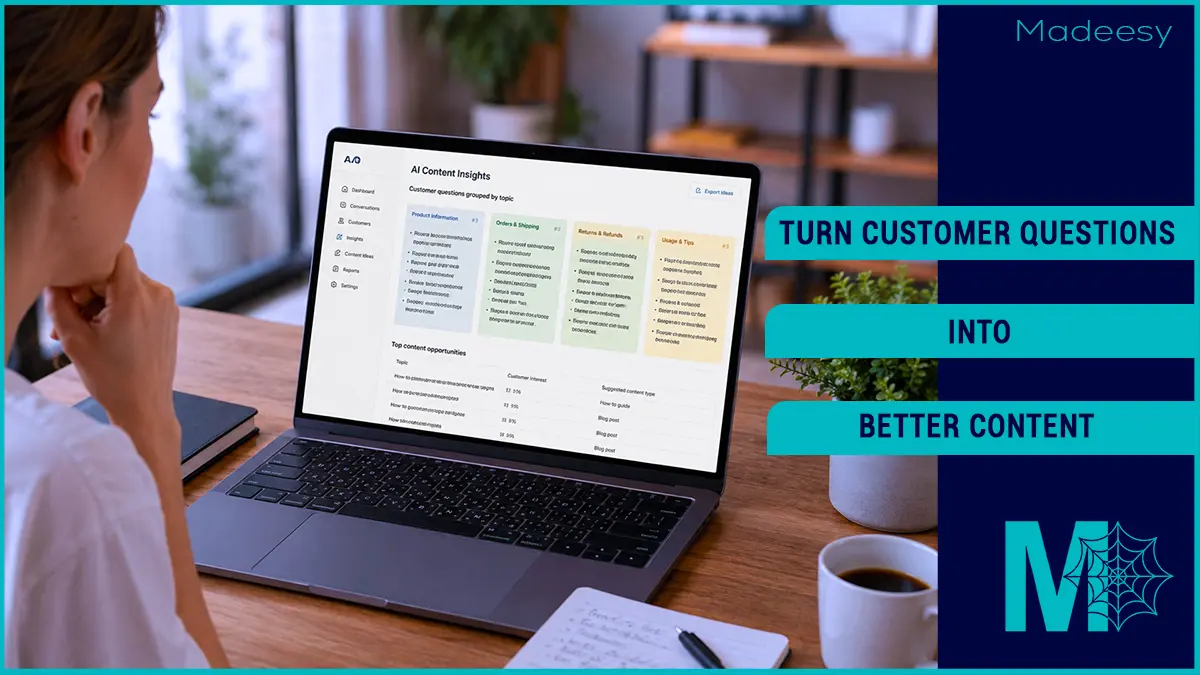
There is a better starting point sitting in every business’s inbox, phone log and comment section: the questions customers are already asking. Real enquiries carry context, hesitation, and specific detail that a keyword list never will. AI does not replace that raw material, but it can help a business organise it, spot the patterns inside it, and turn it into content that answers something a customer genuinely wanted to know.
This is easier to explain with a real example than a hypothetical one, so this article uses Madeesy, a business automation platform, and Wildfire, an Australian intimate wellness brand, as a working case study throughout.
Start with customer problems, not keywords
Before Wildfire used AI in this way, most customer questions arrived through the website enquiry form, phone calls and, to a lesser extent, Instagram messages. They were answered individually, usually by the same person, and then largely forgotten. There was no consistent way of recording them or noticing when the same concern kept showing up in different forms.
That is a common pattern in small businesses. The knowledge exists, but it lives in someone’s memory or a scattered email history rather than anywhere that can inform content decisions. A single customer question rarely justifies a blog article on its own, but a recurring question almost always does, and recurrence is exactly what gets missed without a system for tracking it.
Some of Wildfire’s strongest content ideas have come directly from real enquiries rather than generic industry topics. Customers have asked whether particular massage oils are appropriate to consider during pregnancy and what precautions may be relevant, how pheromone perfumes are meant to work when applied to the skin, and how to put together a couples massage experience at home. Each of those started as one person’s specific concern, not a keyword with search volume attached to it, which is part of why the resulting content tends to feel more useful than a generic overview would.
Use AI to organise recurring questions
Differently worded questions often share the same underlying problem, and this shows up constantly in practice. Customers frequently ask the same thing in noticeably different ways, particularly when they feel uncertain, a little embarrassed, or are trying to describe a situation that is genuinely a bit complicated. A message that starts by describing a relationship issue may end with an indirect product question, and spotting that requires reading between the lines rather than just scanning for keywords.
This is where AI earns its place in the process. It can help interpret what a customer is actually asking when a message contains several statements, concerns and indirect questions bundled together, and it can group similar enquiries into broader themes rather than treating each one as a one-off. A business that receives dozens of variations on “what should I get for my partner?” can use AI to recognise that as a single recurring theme worth addressing properly, rather than fifty separate, unrelated conversations.
Grouping related questions this way also produces better content than answering them individually ever could. Instead of responding to each wording separately, a business can identify the concern underneath all of them and build one resource that covers the main question, the likely follow-up questions, and any relevant safety or practical considerations in one place.
AI needs correcting, not just prompting
It is worth being honest about where AI initially gets things wrong, because that failure is itself instructive. When AI was first used to help interpret Wildfire’s customer questions and content needs, it occasionally treated the word “Wildfire” as a bushfire reference rather than the name of an intimacy and body-care brand, which is a useful reminder that AI has no real understanding of a business unless it is given one. It also sometimes introduced ingredients Wildfire does not actually use, such as certain essential oils, based on assumptions about what a generic product in that category typically contains.
Neither error is unusual, and neither is a reason to avoid AI. It is a reason to treat its output as a first draft of understanding rather than a final answer. AI can recognise patterns across a large number of questions, but it does not automatically understand the details that make one business, or one product, different from a generic competitor in the same category. That gap has to be closed by someone who actually knows the business, and closing it is not optional if the resulting content needs to be accurate.
Find the gaps competitors have not answered
The same organising ability that works on customer questions also works on competitor content. AI can scan a set of competitor articles and flag what they have covered well, and more usefully, what they have left out. A business selling accounting software might find that every competitor has written about choosing the right platform, but nobody has written about migrating existing records out of a spreadsheet without losing anything, which is often the more anxious, more specific question people are actually searching for by the time they are ready to switch.
This matters because the gap is usually where the more useful article lives. Competitors tend to cover the obvious, top-of-funnel questions well, since those are the ones with the most search volume and the least writing effort involved. The unanswered, more specific questions are often exactly the ones a real customer would ask before making a decision, which makes them worth more per reader even if they attract a smaller audience.
Validate the idea before writing it
Not every question deserves a full article, and this is one of the places AI is genuinely useful for narrowing down a list rather than expanding it. Before committing time to a topic, it helps to check whether it actually aligns with what customers are trying to accomplish and with the business’s own goals, rather than assuming that because a question was asked once, it is worth answering in fifteen hundred words.
Wildfire’s experience with the “what should I get for my partner?” question is a good illustration of why validation matters. There is rarely one automatic answer to that question. It usually depends on whether the person has tried the brand before, what kind of gift they have in mind, whether there are any ingredient or scent sensitivities to consider, which fragrances the recipient tends to enjoy, and whether they want a single product or a set. For someone who likes the idea of the oils but cannot decide between them, a gift pack containing all three tends to be the better recommendation, since it presents well as a gift and lets the recipient work out their own preference over time.
That level of nuance is exactly why AI is useful for organising the decision tree behind a question like this, but not for making the final call. It can lay out the branching logic; it still needs accurate product knowledge and a real understanding of the business to fill it in correctly.
Prioritise based on business value
Once a shortlist of validated ideas exists, the next question is which ones to actually write first. A pricing guide that directly reduces the number of “how much does this cost?” enquiries a business fields every week is often more valuable than a general industry news piece, even if the industry piece feels more interesting to write. Ranking ideas by their potential to generate leads, reduce repetitive support questions, or genuinely educate a customer before they buy is a more useful filter than picking whatever topic feels timely.
Operational data can sharpen this further. Anonymised sales trends, frequently purchased products, seasonal demand patterns and common customer mistakes are all legitimate sources of content inspiration that most small businesses already have sitting in their own systems, even if nobody has looked at them through that lens before. Operational tools can also help owners identify patterns in what is selling, what is being returned and where customers may need more information.
As AI-native CMS platforms evolve, the goal is not just to manage content but to connect customer conversations, operational data, content performance, and publishing into a single workflow.
That broader shift reflects how businesses are beginning to use AI to turn everyday operational information into more informed content decisions.
Madeesy’s SalesTracker, for example, records sales, stock and daily business performance thus creating a clearer operational picture that may reveal useful questions for future content.
One question, several pieces of content
A single well-understood customer question rarely has to become just one article. The same underlying question can be turned into a blog article, a short FAQ entry, a social media post, a brief video, or an email newsletter item, each suited to a different part of how customers actually consume information. This is a straightforward way to get more value out of the research that has already gone into understanding the question properly, rather than starting from scratch for every format.
Keep a human in control of the final answer
None of this works if AI is treated as the final authority rather than a research and organising tool. People still need to verify facts, add real experience, and make sure the content reflects the business’s actual voice and actual products, not a generic version of the category it belongs to.
Privacy deserves a direct mention here, because it is easy to get wrong. Having the right wording in a privacy policy does not automatically make it acceptable to feed raw customer messages into an AI tool. Before placing any customer message into an AI system, names, email addresses, order numbers and other identifying details should be removed first. It is also worth checking the specific privacy and data-use settings of whatever tool is being used, and making sure the business’s handling of customer information stays consistent with its own stated obligations, rather than assuming a policy document covers it by default.
More broadly, AI should not be allowed to make final business decisions or to have its first answer accepted as correct by default. The owner still needs to decide whether a recommendation actually makes sense, whether it reflects the business accurately, and whether it serves the long-term interests of both the customer and the business, especially in categories where getting the detail wrong has real consequences for the customer reading it.
Measure what actually attracts customers
Publishing an article is not the finish line. The more useful question is what happens after it goes live: which pieces generate enquiries, newsletter sign-ups, sales, or repeat visits, and which ones simply sit there unread. That data is what should shape the next round of content decisions, rather than starting the whole process over from a blank page each time.
As business tools become more connected, the opportunity is to bring customer questions, operational patterns and content performance into a clearer decision-making process. The goal is not to automate every decision, but to give owners better information before they make one.
A practical workflow
Put together, the process looks like this:
Collect the questions customers are actually asking, from every channel they use to ask them.
Use AI to organise those questions into recurring themes rather than one-off enquiries.
Research what competitors have already covered, and where the gaps are.
Validate that a given idea actually matches customer intent and business goals.
Prioritise ideas based on their likely business value, not just interest level.
Create the content, with a person adding real experience and checking accuracy throughout.
Measure what the published content actually does once it is live.
Repeat the cycle using the new questions and feedback that come in afterward.
None of these steps require a large team or an expensive tool set. What they require is a willingness to actually collect and look at the questions a business is already being asked, and to treat AI as something that helps make sense of that information rather than something that replaces the judgement needed to act on it.
Most companies don’t struggle to launch an AI pilot. They struggle to turn that pilot into something people actually use every day. A demo works because it only has to answer a few carefully chosen questions. Production is different: the system has to pull real account data, follow company policy, handle the request nobody planned for, and know when to hand off to a person. That gap, between “the demo worked” and “this now runs the business,” is where most AI initiatives quietly die.
The numbers back this up. McKinsey’s November 2025 State of AI survey found that 88% of organizations now use AI regularly in at least one part of the business, but only about 39% can point to any real effect on company-wide profit, and just 5.5 to 6% see a meaningful one (5% or more of EBIT, the standard measure of operating profit). RAND’s 2024 research put the failure rate for AI projects above 80%, roughly double the failure rate of ordinary IT projects. MIT’s Project NANDA, publishing in August 2025 after reviewing 300 real deployments, found that about 95% of generative AI pilots never produce a measurable financial return.
These figures don’t argue against using AI. They describe what usually goes wrong, which is useful because it shows what to build differently. The model can usually do the job. The harder part is fitting it into the company’s existing systems, workflows, and decision-making: the unglamorous work of integration, ownership, and oversight that never shows up in a demo.
This roadmap is written for teams that have already run a pilot, or are running one now, and are asking a more specific question than “should we use AI.” They’re asking why the pilot isn’t turning into anything permanent, and what has to change so the next one does.
Where AI projects actually break down
It helps to know exactly where in the process things fall apart, because that determines the fix.
Most pilots die before they ever reach production. S&P Global Market Intelligence’s 2025 research found the average company scrapped 46% of its AI proofs-of-concept (early working tests, short for POCs) before they reached production, and only 48% of AI projects reach production at all. The ones that do make it take about 8 months on average, long enough for the original sponsor to change jobs and for the project’s urgency to fade.
Projects built entirely in-house fail more often than ones built with a vendor or implementation partner. MIT’s Project NANDA found in-house builds succeeded at roughly half the rate of vendor-supported ones. Connecting an AI tool to a company’s real systems (the ERP, the CRM, the ticketing platform, identity and access controls) is harder than it looks, and vendors who have done that integration work before tend to get there faster.
Weak governance is now the top reason agentic AI projects get cancelled. Gartner’s June 2025 forecast, that more than 40% of agentic AI projects will be cancelled by the end of 2027, points to rising costs, unclear business value, and weak risk controls, not the technology itself. Gartner also estimates that of the thousands of products currently marketed as “agentic AI,” only about 130 vendors have genuine multi-step autonomous capability; the rest are existing chatbots or automation tools rebranded to ride the trend.
The companies that do see results tend to redesign the work itself, not just add AI to it. McKinsey’s highest-performing organizations are 3.6 times more likely to pursue real organizational change alongside their AI rollout, and most rebuild the underlying workflow rather than bolt AI onto the old one.
Step 1: Check whether you’re ready to start
Most roadmaps begin with “pick a use case.” That’s premature if three earlier questions haven’t been answered, because the answers decide which use cases are even worth trying.
Is the data actually usable? Can you get to it programmatically, is it clean enough for the task, and does one named person own its accuracy? If the honest answer is “it exists somewhere but nobody’s responsible for whether it’s right,” that’s the real project: fix it first, or pick a different process where the answer is genuinely yes.
Is there a real owner? Every pilot needs one accountable business person, not an IT sponsor, who will still be in that role eight months from now, roughly matching S&P Global’s average time to production. If leadership can’t name that person today, it’s too early to start.
Is success actually measurable? Can the goal be written as one specific sentence before the pilot begins? “Cut average handling time for tier-1 support tickets from 12 minutes to under 6, measured weekly” is testable. “Use AI to improve customer service” isn’t; it has no way to fail, which is exactly how projects drift into permanent pilot status instead of scaling or getting shut down.
Readiness checklist:
Named business owner who will still hold budget authority in 8+ months
Data source identified, accessible, and owned by a named person
Success metric written as one measurable sentence with a baseline and a target
Kill criteria decided before the pilot starts, so everyone agrees what result ends it
Systems the pilot needs to connect to are already identified
Executive sponsor confirmed for the full 6 to 12 month horizon, not just pilot approval
If most of these are missing, close the gaps before starting. Starting anyway just delays the failure, it doesn’t prevent it.
Step 2: Choose a problem AI can actually solve
With readiness confirmed, weigh use cases on three things: how much value is actually at stake if it works, how many systems it needs to touch to be useful, and whether you can build a real evaluation set, not the 30 or 50 example prompts someone wrote in an afternoon, but something that covers edge cases and the ways this specific task tends to go wrong.
Picture a company piloting an AI tool to handle customer support chats. The demo looks great because it answers a handful of pre-selected questions well. In production, it has to pull up a real customer’s account, apply the company’s actual refund policy, deal with the angry customer who didn’t ask a clean question, and know when to hand off to a person instead of guessing. That’s usually where the trouble starts, not because the model got worse, but because the real job was always bigger than the demo showed.
Design the pilot as if it’s the first version of the real system, not a demo: real, access-controlled data, the actual system connections even if sandboxed, and a regular evaluation schedule instead of one review at the end.
Step 3: Build governance alongside the pilot, not after it
Gartner’s research on why agentic AI projects get cancelled points to weak risk controls built too late, not the technology itself. Build governance at the same time as the pilot, not after it proves itself. Before the pilot touches real data, you need:
A human review step for any decision above a set risk level, with someone specific responsible for exceptions
A record of what produced each output, which model version, which data, which prompt or settings (often called “lineage”), kept for later audits
A process for approving changes to the model, prompts, or what an AI agent is allowed to do, so a vendor’s quiet model update doesn’t quietly change how the system behaves
A plan for when it goes wrong, a hallucinated answer to a customer, an agent taking an action it shouldn’t have, a biased outcome. Most companies already have this for security incidents but few have adapted it for AI
An early check on regulation: does this use case fall under a framework like the EU AI Act’s “high-risk” categories, or industry-specific rules in finance, healthcare, or hiring? As of mid-2026, the EU’s high-risk deadlines are being pushed back through a pending legislative process; treat that as a reason to build this capability on a sensible timeline, not a reason to skip it.
This is also where buying tends to beat building most clearly: governance tooling, audit logs, access controls, evaluation frameworks, is often faster to get from a vendor than to build from scratch.
These controls sit in four layers, each with a different owner. Treating them as one undifferentiated “governance” task is a common reason the work stalls, since no single role is positioned to own all four.
Governance framework layers
Layer
Purpose
Example controls
Typical owner
Policy & oversight
Sets risk appetite and who can approve what
AI governance charter, approval criteria, a cross-functional review group
Test against the metric from Step 1, with three things most pilots skip. Use a comparison group, a similar team still using the old process, so you can tell whether the improvement actually came from the AI, rather than from the extra attention, training, or supervision that naturally comes with running a pilot. Evaluate weekly, not just at the end, so problems surface early instead of showing up as a surprise in the final report. And build a cost model that includes integration and governance work, not just the API bill: Neomanex’s 2026 analysis of enterprise AI adoption found that successful projects put about 47% of their budget into this foundational work, versus about 18% in projects that ultimately failed. That gap, more than the total spend, is the useful signal.
At the end of the pilot, make an actual decision: scale it, redesign and try again, or kill it. Skipping that decision is how organizations end up stuck in what McKinsey calls “pilot purgatory”: its data shows roughly two-thirds of organizations still experimenting rather than having either committed to or walked away from their AI initiatives.
Step 5: Get the system ready for everyday use
This is the step most in-house projects underestimate, and it’s where a pilot plan and a real production plan diverge.
Connect it properly to real systems: authenticated access to the ERP, CRM, ticketing platform, or knowledge base, with clear agreements about what data flows where, rather than a fragile one-off connection.
Test it under real load, not pilot-scale traffic. Many pilots run on a fraction of actual volume and never surface the latency, cost, or error-rate problems that only show up at scale.
Watch how it behaves in production: track output quality, catch it if performance drifts over time, monitor cost per transaction, and have a clear path to escalate when the system isn’t confident.
Review the security angle specific to AI: prompt injection, data leaking out through tool use (especially relevant for agents with access to internal tools), and confirming access controls for anything the AI can actually do, not just say.
Prepare the people, not just the system. Deloitte’s research and several other industry analyses point the same direction: most AI failures trace back to people and process, not the algorithm. The team whose job is changing needs training, a clear way to escalate when the AI is wrong, and enough notice that they’re not discovering the project on launch day.
Step 6: Scale what actually works
Scaling isn’t “turn it on for more people.” It’s repeating Steps 3 through 5 for each new team or use case, but with the governance and integration work now reusable instead of rebuilt from scratch. Companies that treat their first production system as a template, with reusable evaluation tools, reusable governance, and a documented way to connect to systems, scale faster than those treating every new use case as its own project. ModelOp’s 2026 benchmark found over 100 proposed AI use cases against fewer than 25 actually in production at the average enterprise: the bottleneck is reusable infrastructure, not ideas.
At this stage, add: a cross-functional group with real authority to approve, pause, or retire AI systems; ROI tracked across the whole portfolio, not just project by project; and a retirement policy for systems that no longer earn their keep, which matters just as much as the approval process does.
Roadmap timeline and gates
Step
Typical duration
What has to be true to move on
Step 1: Readiness check
1–3 weeks
Checklist items closed or each gap has a named owner and a date to close it
Step 2: Pick the problem, design the pilot
2–4 weeks
Evaluation set and pilot design signed off by the business owner
Step 3: Governance foundation
Runs alongside Steps 2–4
All four governance layers in place before real data is touched
Step 4: Run the pilot
6–12 weeks
A clear scale / redesign / kill decision against the original metric
Load-tested, monitored, security-reviewed, and live with real users
Step 6: Scale
Ongoing
Governance and evaluation tools are reusable, so each new use case moves faster than the last
Build, buy, or partner
Choosing among the best enterprise AI solutions depends on more than the model itself. Companies also need to consider how quickly a solution can be deployed, how well it integrates with existing systems, and whether the business has the internal expertise to build and maintain it.
Factor
Favors building it yourself
Favors buying it
Favors a vendor/implementation partner
It’s a real competitive differentiator
Yes
No
Possible (co-build)
You have deep internal ML/data engineering capacity
Yes
N/A
N/A
Time-to-production is a hard constraint
No
Yes
Yes
It has to connect to many systems
Higher risk
Depends on the vendor
Yes, usually a vendor’s strength
Compliance requirements are well-defined and common
N/A
Yes, the vendor likely already handles it
Yes
You have budget for ongoing internal maintenance
Yes
Lower ongoing burden
Shared
MIT’s finding, that vendor-supported deployments succeed roughly twice as often as in-house ones, isn’t an argument to buy everything. It’s an argument to be honest about which of the factors above actually apply before defaulting to building it yourself, which often turns out slower and more expensive than it looks on a budget line.
Common pitfalls
No measurable success metric at approval, the reason that comes up most often across the RAND, MIT NANDA, and S&P Global research.
Treating the pilot’s evaluation set as good enough for production, a handful of hand-picked prompts doesn’t represent real production traffic.
Underestimating integration as “a few API calls,” usually where in-house timelines blow past the 8-month average.
Building governance after the pilot succeeds, rather than alongside it.
No accountable business owner past the pilot, IT-sponsored projects without one rarely survive a budget review.
Buying “agentic” without checking whether it actually is, given how few vendors marketing agentic AI have genuine capability, this deserves a specific vetting step.
No kill criteria, without a defined way to fail, pilots don’t die, they just quietly consume budget.
Measuring ROI in a way that survives a board meeting
With boards increasingly asking how companies can make money with AI, and most organizations still unable to show enterprise-level impact, ROI needs three things to hold up under scrutiny: a comparison group, so the result can be attributed to the AI rather than to concurrent process changes; a fully loaded cost that includes integration, governance, and the human oversight time the system actually requires, not just the license fee; and a measurement window agreed before the pilot starts, so the final number can’t be accused of being cherry-picked from the best week.
A hypothetical example
This scenario is a composite, built to show how the pieces above fit together. It doesn’t describe a real company, a real Madeesy client, or actual figures.
A mid-market logistics company pilots an AI tool to draft responses to routine shipment-status questions. It does what Step 1 asks: a named owner (the customer service director), a measurable goal (cut first-response time from 6 hours to under 1, measured weekly), and a small evaluation set. Six weeks in, the goal is met.
Then the project stalls for four months, not because the AI stopped working, but because Step 3 was never scoped alongside the pilot. There’s no process for when the vendor updates its model, no record of what produced a wrong answer that got escalated to an angry customer, and no one assigned to review the roughly 3% of responses flagged as low-confidence. Governance was never made responsible for lineage logging during Step 2, so nobody owned it until the pilot’s own success forced the question.
Done the way this roadmap describes, the same company assigns governance as responsible for lineage logging from the start, builds the technical-controls layer alongside the pilot instead of after it, and reaches “production-ready” inside the original pilot window, not four months later.
FAQs
How long should a pilot run before deciding to scale or kill it? Usually 6 to 12 weeks for a well-scoped pilot with real data, long enough to trust the result, not so long that urgency fades. Companies that reach production average about 8 months total, so the pilot itself should be a small piece of that, not most of it.
What predicts whether a pilot reaches production? Having a specific, measurable goal before the pilot starts. It’s the factor that comes up most consistently across the RAND, MIT NANDA, and S&P Global research reviewed here.
Should we build our own AI agents or buy from a vendor? Use the build/buy/partner table above rather than a blanket rule. Vendor-supported projects succeed more often mainly because integration is harder than expected, but building in-house still makes sense when the use case is a genuine differentiator and your team has the capacity.
How many AI use cases should be in production at once? Fewer than most companies attempt. ModelOp’s 2026 benchmark found over 100 proposed use cases against fewer than 25 in production; the gap is rarely a shortage of ideas.
Does the EU AI Act matter if we’re not based in Europe? Possibly, it applies to AI systems that affect people in the EU, regardless of where the company is based. The high-risk deadlines have been shifting, so confirm the current timeline directly rather than relying on any single article.
Closing thought
The companies beating these failure rates aren’t using better models or bigger budgets. They have a named owner, a measurable goal set before the pilot starts, and governance built alongside the work instead of after it succeeds. None of that is a technology problem, which is also why a better vendor alone won’t fix it. Treat this roadmap as how you run AI projects going forward, not a one-time plan for a single pilot.
Sources
RAND Corporation, AI project failure rate analysis, 2024
MIT Project NANDA, “The GenAI Divide” (Aditya Challapally et al.), August 2025
McKinsey & Company, “The State of AI: Global Survey 2025,” November 5, 2025, mckinsey.com/capabilities/quantumblack/our-insights/the-state-of-ai
Gartner, Inc., “Gartner Predicts Over 40% of Agentic AI Projects Will Be Canceled by End of 2027,” press release, June 25, 2025, gartner.com/en/newsroom
S&P Global Market Intelligence, enterprise AI proof-of-concept and production research, 2025
ModelOp, 2026 enterprise AI production benchmark (cited via secondary reporting)
Deloitte, enterprise AI failure cause analysis, organizational vs technical (cited via secondary industry reporting)
Neomanex, 2026 enterprise AI adoption analysis (cited via secondary reporting)
EU Digital Omnibus on AI, provisional political agreement, May 7, 2026, and related EU AI Act timeline tracking (cross-verified across multiple legal-industry trackers)
AI is now a necessity that we cannot ignore nomatter what. Recent studies show that three in four knowledge workers (75%) now use AI at work. That means if you want to stay ahead with enterprise artificial intelligence solutions, AI isn’t just an option—it’s a necessity.
The businesses that thrive will be the ones using AI to:
Streamline processes
Deliver insights
Automate tasks
Drive efficiency at scale
Enterprise AI solutions and platforms focus on the unique challenges big companies face, like handling large data volumes and ensuring data security. But not all enterprise AI platforms are built with the scale, security, or structure to support what your organization needs, so you should choose wisely.
If you’re planning to implement AI in your organization, explore our AI Solutions services to discover how Madeesy helps businesses design, develop, and integrate intelligent AI systems.
Quick Facts on Enterprise AI
What you need to know:
Market reality: In 2026, the Enterprise AI market is USD 116.6 billion. Projections show that by the year 2035 the market will have grown to USD 558 billion which means(19% CAGR)Adoption: 87% of large enterprises already use AI; SMBs growing at 38.6% CAGRROI timeline: 6-12 months payback with structured implementation; 34% efficiency gains, 27% cost reduction within 18 monthsImplementation: 4-8 weeks for out-of-the-box solutions; 3-6 months for custom implementations15 solutions reviewed: From Saleseasy (Sales automation) to NVIDIA (AI infrastructure)Key decision factors: Security, integration, scalability, time-to-value, change managementSuccess rates: 47% of AI deals go to production (vs. 25% for traditional software)
Read this article if you’re: evaluating enterprise AI platforms, planning AI implementation, benchmarking against industry standards, or determining ROI expectations.
What Is Enterprise AI?
Enterprise artificial intelligence is more than just advanced machine learning algorithms—it’s a system designed to understand, adapt, and integrate within the complex operational structures of large organizations.
Unlike consumer AI, which prioritizes accessibility and ease of use, AI for business and enterprise automation tools must operate at scale while maintaining strict security, compliance, and contextual awareness.
The key differences between enterprise AI and standard business AI lie in:
Contextual awareness: Enterprise AI must understand nuanced roles, responsibilities, and access levels within an organization—not just process data.
Architectural integrity: The foundation of enterprise AI determines its ability to work securely and effectively within an enterprise ecosystem.
Security and compliance: Unlike consumer AI, which prioritizes seamless adoption, enterprise AI requires rigorous validation and safeguards against risks like data leaks.
Simply adopting an AI tool with the most features isn’t enough, complexity doesn’t always equate to effectiveness, its even said that beyond complexity lies simplicity.
Unlike consumer AI, which might assist with generic tasks like summarizing reports, enterprise AI in this case provided real-time, role-specific insights while maintaining strict data governance. For example, Unity used enterprise AI to cut IT problem resolution time from three days to less than a minute, leading to a 91% employee satisfaction rate.
In short, success in your enterprise AI strategy depends on the architecture, security, and adaptability of the solution — not just the version of the model you deploy, but how well it integrates and operates within your organization.
What is an enterprise AI solution?
An enterprise AI solution is a type of software designed to incorporate AI-enabled technologies into large organizations. Leading enterprise AI platforms include these key application types:
Enterprise Resource Planning (ERP) Optimization:
Integrated Data Analytics: Enhance ERP systems with AI to analyze cross-departmental data.
Resource Management: Optimize resource allocation and utilization.
Intelligent Automation:
Robotic Process Automation (RPA): Automate repetitive tasks company-wide.
AI-driven Workflows: Streamline processes across departments.
Predictive Analytics:
Business Forecasting: Predict sales, market trends, and financial performance.
Risk Management: Mitigate risks affecting various business areas.
Data-Driven Decision Making:
Unified Data Platforms: Consolidate data for comprehensive insights.
Virtual Assistants: Assist employees with tasks like scheduling and information retrieval.
Talent Development: Personalize training and career development programs.
5 examples of enterprise AI at work
Enterprise AI offers a wide range of use cases and supports every department across the organization, including:
Human resources: AI revamps HR by automating tasks like resume screening and staff scheduling. HR can make better hires and manage employee needs more efficiently.
Customer service: AI-powered chatbots improve customer experiences with 24/7 support. These chatbots resolve common issues quickly, freeing up human agents for more complicated cases.
Sales: Predictive data analytics guides sales teams in identifying potential customers and tailoring personalized marketing strategies, boosting conversion rates, and improving the overall customer experience.
Engineering: AI streamlines process automation in engineering work, such as predictive maintenance, forecasting equipment failures, and reducing downtime.
IT: Enterprise AI assists IT departments by autonomously resolving or triaging and routing support tickets, helping staff reduce mean time to resolution (MTTR).
Why Businesses Need Enterprise AI in 2026
Ignoring the potential of enterprise AI solutions and AI automation tools puts your business at a disadvantage. Stay competitive by integrating AI for business across your enterprise to gain key benefits like:
Improved efficiency and productivity: by automating tasks and processes. In fact, AI is expected to improve productivity around the world by up to 1.5% annually and drive significant GDP growth.
Enhanced decision-making: through data-driven insights.
Increased agility and responsiveness: to changing market conditions.
Reduced costs: by optimizing resources and streamlining operations.
Improved customer experience: through personalized interactions and support
Greater innovation: by enabling new products, services, and business models
However, not all AI solutions are created equal. The best enterprise AI platforms must be contextually aware, architecturally sound, and built for business needs—not just packed with features. When comparing enterprise AI solutions, you should understand each platform’s strengths, limitations, and ideal use cases.
How to Choose the Right Enterprise AI Platform and Solution
Before evaluating specific vendors, consider these critical factors that apply across all enterprise AI solutions. A thorough assessment ensures you select a platform that aligns with your organization’s technical requirements, business goals, and operational readiness.
Data Security and Compliance
Enterprise AI platforms must meet your industry’s regulatory requirements—whether HIPAA, GDPR, CCPA, or SOC 2 compliance. Evaluate how vendors handle data encryption, access controls, and audit trails. Ask whether the solution supports data residency requirements and how it manages sensitive information across departments. Security isn’t optional; it’s foundational to enterprise adoption.
Integration with Existing Systems
Your enterprise AI solution won’t operate in isolation. It needs to connect seamlessly with your ERP, CRM, ITSM, HRIS, and other critical systems. Review the vendor’s API documentation, pre-built connectors, and integration capabilities. Consider whether they offer native integrations with your current tech stack or if you’ll need custom development. Poor integration creates bottlenecks and undermines ROI.
Scalability and Performance
As your organization grows, your AI platform must scale without degradation. Assess how the solution handles increased data volume, user load, and complexity. Ask about performance benchmarks, infrastructure requirements, and whether the platform can support your projected growth over three to five years. A solution that works well in pilot may falter at enterprise scale.
Time-to-Value Expectations
Enterprise deployments take time. Understand the realistic timeline for implementation, from initial setup through full organizational adoption. Some solutions deliver value in weeks; others require months of customization. Factor in your organization’s capacity for deployment activities and whether the vendor provides implementation support. Faster time-to-value often justifies premium pricing.
Change Management and Adoption Risks
Technology alone doesn’t drive success—people do. Evaluate the vendor’s training resources, documentation, and user support. Consider whether the solution requires significant workflow changes or if it adapts to existing processes. Assess adoption risk by reviewing customer case studies and asking about average user adoption rates. Organizations often underestimate change management complexity, so be realistic about internal resources needed for successful rollout.
Use these criteria as your evaluation framework. No single solution excels in every area, so prioritize based on your organization’s most pressing needs.
Best Enterprise AI Software 2026: 15 Solutions Compared
Finding the right AI solution for your business can feel overwhelming, but it doesn’t have to be.
The best-in-class enterprise AI platforms and solutions provide flexible, scalable options that suit a wide range of business needs.
Whether you’re looking to streamline IT support, boost customer service, or automate workflows, there’s an enterprise AI platform for you. Here are 15 top enterprise AI solutions that can transform your business operations:
Enterprise AI Market Context and Growth
The enterprise AI market is expanding rapidly, with significant implications for business strategy. Understanding market trends helps organizations benchmark their AI investments and adoption timelines.
Market Size and Growth Trajectory
The global enterprise AI market is valued at USD 98 billion in 2025 and is projected to reach a valuation of USD 558 billion by the end of 2035, rising at a CAGR of 19% during the forecast period. In 2026, the industry size of enterprise AI is estimated at USD 116.6 billion. By deployment model, cloud accounted for 69% of the enterprise AI market share in 2024, while hybrid and edge configurations are projected to expand at a 24.05% CAGR to 2030.
Adoption Rates by Company Size
Large enterprises lead adoption but small and medium enterprises are catching up rapidly. Enterprise AI adoption has reached mainstream status with 87% of large enterprises implementing AI solutions, with annual investment averaging $6.5M per organization and process automation leading adoption at 76%. By organization size, the small and medium enterprises segment is predicted to experience the quickest CAGR of 38.6%. U.S. SMB adoption increased from 14 percent to 39 percent in one year, with 55 percent expected to use AI by 2025.
Productivity and Cost Impact Benchmarks
Organizations report measurable gains from enterprise AI deployment. Organizations see 34% operational efficiency gains and 27% cost reduction within 18 months. Companies implementing AI-driven automation experience 20-30% lower operational costs and efficiency improvements exceeding 40%. The average anticipated or realized productivity improvement from Gen AI implementations was 22.6%, with some studies reporting that ChatGPT can improve worker productivity by 37%.
Time-to-Value Averages
Implementation speed varies by solution type. Once an organization commits to exploring an AI solution, deals convert at nearly twice the rate of traditional software: 47% of AI deals go to production, compared to 25% for traditional SaaS. Organizations that follow structured implementation approaches typically see measurable ROI within 6-12 months, as discussed in the implementation section below.
1. Saleseasy
Best for:IT automation and employee support
Harnessing the power ofagentic AI, Saleseasy delivers reliable enterprise AI solutions that serve your entire business out of the box.
Saleseasy helps enterprises deploy enterprise AI platforms in ways thatenhance efficiency and productivity across the organization—not just a single department. From streamlining talent acquisition to enabling self-service IT assistance, Saleseasy delivers a true enterprise-wide solution.
Key features:
AI assistant: Automates complex, repetitive tasks, reducing workload for your support teams
Enterprise search: Lets employees instantly find the information they need with natural language processing
Real-time analytics: Delivers insights for better decision-making
Seamless integrations: Able to connect with your ERP, CRM, ITSM, HRIS, and other enterprise systems
Robust security: Meets high compliance and regulatory standards
Request a demo to see how it works.
2. Salesforce Einstein
Best for:CRM-driven organizations and sales/service teams
Launched in 2016, Salesforce Einstein delivers enterprise AI solutions withpredictive analytics capabilitiesand AI-driven insights across business functions.
It’sseamlessly embedded into Salesforce’s CRM, helping your organization use AI for business without extensive data preparation or management.
Key features:
Einstein Bots: Automate customer service interactions by handling routine queries, freeing up your human agents to tackle more complex issues.
Einstein Prediction Builder: Create custom AI models to predict outcomes, such as lead conversion rates or likelihood of customer churn, without needing to write a single line of code.
Einstein Vision and Language: Recognize images and analyze text to gain a deeper understanding of customer interactions and preferences.
3. H2O.ai
Best for:Data science teams and custom ML model development
H2O.ai offers an enterprise AI platform thatintegrates seamlessly across multiple environments, including cloud, on-premises, and hybrid deployments.
Key features:
AutoML capabilities: H2O.ai’s automated machine learning (autoML) streamlines the model-building process, making it faster and more efficient without sacrificing accuracy or transparency.
Explainable AI: The platform offers robust tools for machine learning interpretability, enabling users understand the decisions made by their models and building trust among stakeholders.
Scalability: With full NVIDIA RAPIDS integration, H2O.ai provides high-performance cloud computing capabilities that support massive scale workloads using both CPUs and GPUs.
4. Google Cloud AI
Best for:Cloud-native enterprises and scalable AI infrastructure
Google Cloud AI delivers enterprise AI solutions with thesame high performance and reliabilitythat users expect from the cloud provider. You getscalable, secure, and powerful AI systemsto help your business stay competitive.
Key features:
Customer Engagement Suite: Provides customizable virtual machines (VMs) that offer high-performance AI capabilities. Compute Engine’s Tau VMs are known for their exceptional price-performance ratio.
Document AI: A set of tools that use AI to extract, analyze, and classify information from documents. Document AI supports various document formats and helps businesses automate data entry and improve accuracy.
Vertex AI: Helps boost conversions and lower abandonment with search, browsing, and recommendations on your digital properties.
5. Glean
Best for:Knowledge discovery and workplace search
Glean provides anAI-powered workplace search and knowledge discovery platform, enabling employees to quickly find relevant information across various enterprise systems and tools. It’s acentralized enterprise AI platformthat connects, secures, and makes sense of your company’s data, powering search, automation, and AI agents.
Key features:
Document AI: Using AI technology, Glean can extract, analyze, and classify information from documents, making data entry easier and improving accuracy.
Generative AI: Glean’s platform allows you to build generative AI apps that automate tasks like answering FAQs, handling IT requests, and generating domain-specific content.
Enhanced Data Governance: Glean supports sensitive data discovery, GDPR and CCPA compliance, and user access review, ensuring a secure and compliant AI ecosystem.
6. Aisera
Best for:Workflow automation and low-code/no-code AI agents
Aisera provides auniversal AI copilot with agentic reasoning and orchestration. It uses domain-specific LLMs and proactive AI agents to deliver enterprise AI solutions thatunify workflows, automate tasks, and provide insights across your whole organization. You can also create custom enterprise AI agents using various low-code/no-code tools.
Key features:
AI search capability across your entire organization: Find exactly what you need, when you need it — no matter where it’s stored so you can get answers to your questions.
Universal AI Copilot: Streamline your operations with one AI Copilot that connects all your tools and systems. Deliver seamless, proactive support across every department to save time, reduce costs, and keep your teams in sync.
Agentic reasoning and orchestration: Get tasks done right the first time with an AI that truly understands your business needs. Aisera’s Copilot delivers personalized, accurate responses and actions.
7. Microsoft Copilot
Best for:Microsoft 365 users and productivity enhancement
Microsoft Copilot is anAI-powered tool designed to improve productivityby integrating into Microsoft 365 applications. It usesgenerative AI and large language models (LLMs)to provide intelligent suggestions and help you generate content, analyze data, and automate tasks with enterprise AI capabilities.
Key features:
Content generation: Copilot can help you create drafts, generate ideas for documents, and rewrite sections of text to improve clarity and style.
Data analysis: In Excel, Copilot can analyze data, suggest trends, create visualizations, and generate summary insights
Meeting insights: Copilot can provide summaries of meetings, highlight key points, and suggest action items, helping you stay on top of your tasks
8. Microsoft Azure AI
Best for:Custom AI development and multi-model deployments
Microsoft’s Azure AI providestools and resources enterprises need to build custom enterprise AI solutionsand solve business challenges at scale.
Key features:
Azure AI Model Catalog: Access over 1,700 foundation models from top creators.
Azure AI Foundry (formerly AI Studio): Build, customize, and manage AI agents and apps for countless use cases.
Azure AI Content Safety: Ensure responsible AI use with robust security, data protections, and custom filters.
Azure offers on-demand, resource-based pricing models. Did you know that Microsoft and Saleseasy can work together? Saleseasy is available for purchase via the Azure Marketplace, allowing organizations to use their pre-committed Microsoft Azure Consumption Commitment (MACC) spend toward Saleseasy licensing.
9. Coveo
Best for:Customer experience and AI-driven search/recommendations
Coveo is an enterprise AI platform forsearch and generative experiencethat optimizes touchpoints along the customer journey. Coveo offersAI-driven search and recommendationsthat personalize customer interactions to improve the user experience.
Key features:
AI-driven search: Coveo leverages user intent and contextual meaning to provide relevant search results.
Generative answering: Their secure solutions, powered by large language models (LLMs), deliver trustworthy answers.
AI recommendations: The platform predicts and suggests content and product recommendations based on activity and past interactions.
10. IBM Watson
IBM has a long history with AI, from its Deep Blue computer to winning Jeopardy to providing enterprise AI solutions. Today, IBM’s watsonx AI portfolio processes vast amounts of data to support various business applications.
Key features:
watsonx.ai: Train, validate, tune, and deploy foundation and machine learning models with ease.
watsonx.data: Scale AI workloads for all your data—anywhere.
watsonx Assistant: Empower everyone in the organization to build and deploy AI-powered virtual agents without writing a single line of code.
11. ServiceNow
ServiceNow’s enterprise offerings include enterprise AI solutions with predictive analytics and machine learning capabilities that automate routine IT tasks and enhance service delivery efficiency.
Key features:
IT service management (ITSM): Automates and streamlines IT service delivery, helping you manage incidents, problems, and changes efficiently.
Customer service management (CSM): Enhances your customer support by automating service requests, problem resolution, and customer engagement.
Virtual agents: Provide conversational support to users, facilitate workflows, and help to reduce the workload on human support staff.
12. Salesforce Agentforce
Salesforce Agentforce is an enterprise AI solution that provides autonomous support to employees or customers. It connects to various data sources, allowing agents to plan, reason, and execute tasks efficiently.
Key features:
Real-time data access: Agents can connect to data sources and use these in real-time to plan and execute tasks.
Customizable agents: Organizations can create custom agents with specific skills tailored to their needs.
Integration with existing systems: AgentForce can connect to existing APIs or use MuleSoft’s pre-built connectors to integrate with 30+ systems.
13. NVIDIA
NVIDIA AI offers a comprehensive ecosystem of enterprise AI solutions that includes infrastructure, enterprise-grade AI software, and AI models to boost productivity and efficiency across various industries.
Key features:
Generative AI: Enables you and your team to build production-ready generative AI solutions to transform business operations.
Data science: Accelerates data processing and AI training, reducing infrastructure costs and power consumption.
AI Inference: Deploys AI models faster and with higher accuracy, achieving faster insights with lower costs.
C3.ai
Best for: Manufacturing, energy, and large operational enterprises
C3.ai is a purpose-built enterprise AI platform designed for complex operational environments. It specializes in real-time AI applications for industrial use cases, combining large-scale data integration with sophisticated AI models to solve specific business problems in manufacturing, energy, utilities, and supply chain management.
C3.ai emphasizes real-time AI capabilities, allowing enterprises to make instantaneous decisions based on streaming data. The platform handles massive data integration challenges across disparate enterprise systems, enabling organizations to leverage their full data assets without extensive data preparation. Its flexibility supports both pre-built industry solutions and custom AI applications tailored to unique operational needs.
Key features:
Real-time AI: Process streaming data and execute decisions in milliseconds
Large-scale data integration: Connect and consolidate data from multiple enterprise systems without moving data
Industry-specific solutions: Pre-built AI applications for manufacturing, energy, utilities, and supply chain
Scalability and flexibility: Supports custom models and applications alongside pre-built solutions
Operational optimization: Predictive maintenance, demand forecasting, and resource optimization
C3.ai is ideal for large enterprises in operational industries that need sophisticated, real-time AI integrated across complex systems and data sources.
Databricks AI
Best for: Data-driven enterprises and advanced ML teams
Databricks AI is a unified data and AI platform designed for enterprises that need seamless integration between data engineering, machine learning, and analytics. It provides a collaborative environment where data engineers, data scientists, and analysts work on the same platform without data silos or complex handoffs.
Databricks emphasizes enterprise-scale model training, deployment, and cross-cloud support. The platform handles massive data volumes while maintaining governance and security standards required by large organizations. Its lakehouse architecture consolidates data warehousing and data lakes into a single system, reducing complexity and cost.
Key features:
Unified data platform: Combines data engineering, analytics, and AI in one environment
MLflow: Open-source framework for managing machine learning lifecycle, from experimentation to production deployment
Delta Lake: ACID transactions and data versioning for reliable data operations
Multi-cloud support: Deploy across AWS, Azure, and Google Cloud with consistent experience
Enterprise governance: Built-in data lineage, access controls, and compliance tracking
Collaborative notebooks: SQL, Python, R, and Scala in shared notebooks for team collaboration
Databricks is best for organizations with large data teams, complex data pipelines, and the need for advanced ML capabilities at enterprise scale.
Enterprise AI Solutions Comparison Table
Solution
Best For
Core Strength
Deployment Model
Typical Enterprise Use Case
Saleseasy
IT automation and employee support
Agentic AI with enterprise-wide automation
SaaS, cloud-native
Self-service IT support, ticket automation, knowledge management
Salesforce Einstein
CRM-driven organizations
Predictive analytics embedded in CRM
Cloud (Salesforce ecosystem)
Sales forecasting, customer service automation, churn prediction
H2O.ai
Data science and ML teams
AutoML and explainable AI
Cloud, on-premises, hybrid
Custom model development, data analysis, predictive analytics
Google Cloud AI
Multi-cloud infrastructure
Scalable, integrated cloud AI services
Cloud (Google Cloud Platform)
Document processing, customer engagement, AI infrastructure
Business applications, data workload scaling, agent creation
ServiceNow
IT and customer service operations
Integrated ITSM and CSM with AI
Cloud (ServiceNow platform)
Incident management, service request automation, ticket routing
Salesforce Agentforce
Autonomous agent deployment
Real-time data access and autonomous reasoning
Cloud (Salesforce ecosystem)
Customer service agents, employee support, custom workflows
NVIDIA
AI infrastructure and model deployment
High-performance computing for AI
On-premises, cloud, hybrid
Model training, inference optimization, data processing
Best For X: Quick Reference Guide
Best for IT Automation Saleseasy and ServiceNow excel at IT operations. Saleseasy automates ticket resolution and knowledge discovery across the entire organization. ServiceNow integrates ITSM workflows with AI-driven routing and automation. Choose Saleseasy for rapid time-to-value and out-of-the-box deployment; choose ServiceNow if you’re already using ServiceNow platform.
Best for CRM-Driven Organizations Salesforce Einstein and Salesforce Agentforce are purpose-built for Salesforce environments. Einstein delivers predictive analytics for sales and customer service. Agentforce creates autonomous agents that reason with real-time data. Both integrate seamlessly without data migration or complex setup.
Best for Custom ML and Data Science Teams H2O.ai and IBM Watson serve data-heavy organizations. H2O.ai emphasizes AutoML and model interpretability for rapid development. IBM Watson provides access to foundation models and scalable data workloads. Choose H2O.ai for faster model building; choose IBM Watson for enterprise-scale data operations.
Best for Enterprise Search and Knowledge Management Glean specializes in workplace search and knowledge discovery across disconnected systems. It consolidates data governance, compliance, and search in one platform. Ideal for organizations struggling with information silos.
Best for Cross-Functional Automation Aisera provides a universal AI copilot for IT, HR, finance, and custom workflows. Its low-code/no-code agent creation enables rapid deployment across departments. Best for organizations wanting single-platform automation.
Best for Productivity and Content Generation Microsoft Copilot integrates into Microsoft 365 for document creation, data analysis, and meeting insights. Ideal if your organization relies on Word, Excel, Teams, and Outlook.
Best for AI Infrastructure and Model Deployment NVIDIA and Google Cloud AI serve infrastructure-focused needs. NVIDIA accelerates AI training and inference on-premises or in the cloud. Google Cloud AI provides integrated cloud services with document processing and customer engagement tools.
Best for Responsible AI and Customization Microsoft Azure AI provides 1,700+ foundation models with built-in content safety and responsible AI frameworks. Best for organizations requiring custom generative AI with compliance controls.
Best for Customer Experience Coveo optimizes customer journeys with AI-driven search and personalized recommendations. Ideal for e-commerce and customer-facing portals.
How to Use This Comparison
Identify your primary use case from the “Best For X” section
Review the core strengths and deployment models that match your infrastructure
Assess integration requirements with your existing systems (ERP, CRM, ITSM, HRIS)
Evaluate time-to-value expectations based on your implementation capacity
Consider whether you need single-platform consolidation or best-of-breed solutions
Most enterprises benefit from combining solutions. For example, Saleseasy for IT automation plus Salesforce Einstein for CRM analytics. The comparison above helps you identify which combinations serve your business needs.
How Agentic AI Supercharges Enterprise AI Solutions and Platforms
Agentic AI helps enterprise AI solutions and platforms achieve advanced levels of automation, digital transformation, and operational efficiency.
Agentic AI goes far beyond traditional AI:
Dynamic analysis: Adjusts to changes and processes new inputs instead of just following preset instructions.
Contextual awareness: Understands the environment, user intent, and constraints, not just the raw data.
Independent actions: Makes real-time decisions with little to no human help.
Continuous learning: Improves its performance over time by learning from past experiences.
In these ways, agentic AI can help enterprises overcome the technical limitations of traditional AI—think rigid, rule-based processing or a lack of contextual understanding—by offering adaptive, context-aware decision-making and continuous improvement. This enables enterprise AI solutions to deliver greater efficiency, reduced human intervention, and more accurate outcomes.
Saleseasy: Enterprise AI Solution for Agentic Assistance
While there are plenty of enterprise AI platforms out there, Saleseasy delivers an enterprise AI solution that’s out-of-the-box ready and delivers fast time to value. It offers:
Combines powerful search and generative AI with automated actions across your tech stack
Works where employees already collaborate (Slack, Teams, etc.)
24/7 personalized support in 100+ languages
More than 300 companies trust Saleseasy as their enterprise AI solution to support employees worldwide—helping them find answers faster, automate repetitive tasks, and boost productivity.
Unsure if it’s the right enterprise AI solution for you? Take it from our customer, Unity, who dropped their IT problem resolution time from 3 days to less than 1 minute—achieving a 91% employee satisfaction rate.
Frequently Asked Questions
What’s the difference between enterprise AI and regular AI?
Enterprise AI is designed for large organizations with strict security, compliance, and integration requirements. Regular AI (consumer AI) prioritizes ease of use and accessibility for individual users. Enterprise AI must operate at scale, handle sensitive data, integrate with existing systems like ERP and CRM, and maintain compliance with industry regulations like HIPAA or GDPR. Regular AI tools don’t require these enterprise-grade safeguards.
How much does enterprise AI cost?
Enterprise AI pricing varies widely based on deployment model, features, and scale. SaaS solutions like Saleseasy and Salesforce Einstein typically charge per user or per transaction, ranging from thousands to hundreds of thousands annually for enterprise deployments. Platform-based solutions like Azure AI and Google Cloud AI use consumption-based pricing. Custom implementations with H2O.ai or IBM Watson may require significant upfront investment plus ongoing support. Request vendor demos and pricing models tailored to your organization size and use case.
How long does enterprise AI implementation take?
Implementation timelines range from weeks to months depending on complexity and your organization’s readiness. Out-of-the-box solutions like Saleseasy can deliver value in 4–8 weeks. Salesforce Einstein integrates quickly if you already use Salesforce. Custom implementations requiring data preparation, model training, and integration with legacy systems may take 3–6 months or longer. Factor in change management and user adoption time, which often extends timelines beyond technical deployment.
What’s the ROI of enterprise AI?
ROI depends on your use case and implementation. Companies report 30–50% reduction in support ticket resolution time, 20–40% improvement in operational efficiency, and cost savings from automation. Unity reduced IT resolution time from 3 days to under 1 minute, achieving 91% employee satisfaction. Calculate ROI by measuring time saved, cost reduction, improved customer satisfaction, and revenue impact from faster decision-making. Most enterprises see measurable ROI within 6–12 months.
Do enterprises need a data science team to use AI?
No. Modern enterprise AI platforms like Saleseasy, Salesforce Einstein, and Microsoft Copilot require no data science expertise. They’re designed for business users and IT teams. However, organizations building custom ML models with H2O.ai or IBM Watson benefit from data science expertise. Low-code/no-code platforms like Aisera enable non-technical teams to create custom agents. Your data science team can focus on advanced analytics while business teams deploy pre-built AI solutions.
Enterprise AI Implementation Best Practices
Enterprise AI deployments succeed when organizations approach them with realistic timelines, clear team structures, and deliberate change management. Based on successful implementations across industries, here are practical best practices.
Typical Implementation Timeline
Most enterprise AI projects follow this realistic timeline: discovery and assessment (2–4 weeks), pilot deployment (4–8 weeks), full rollout (8–12 weeks), and optimization (ongoing). Out-of-the-box solutions like Saleseasy accelerate this timeline to 4–8 weeks total. Custom implementations with data preparation and model training extend to 3–6 months. Plan for change management and user adoption to add 2–4 weeks beyond technical deployment. Organizations that underestimate timeline complexity often face adoption delays and incomplete value realization.
Team Roles Required
Successful implementations require cross-functional teams: executive sponsor (owns business case and removes obstacles), project manager (coordinates timeline and deliverables), IT infrastructure lead (manages integrations and security), business process owner (defines use cases and workflows), change management lead (drives adoption and training), and vendor implementation partner (provides expertise and support). For custom ML work, include a data engineer and analytics lead. Avoid siloing AI projects within IT; involve business stakeholders from day one.
Training and Onboarding
Most enterprises underinvest in training. Plan for 2–3 hours of initial training per user group, with role-specific content. IT support teams need deeper training (8–16 hours) to troubleshoot and escalate issues. Create simple documentation, video walkthroughs, and quick-reference guides. Establish a “super user” group within each department who become internal advocates and trainers. Ongoing training for new employees should be built into standard onboarding. Organizations with comprehensive training programs see 40–60% higher adoption rates.
Change Management Strategies
Communicate early and often. Share the business case, expected benefits, and timeline transparently. Address concerns about job displacement directly; most AI implementations augment human work rather than eliminate it. Start with enthusiastic early adopters, then expand. Create feedback channels so users can report issues and suggest improvements. Celebrate wins publicly—when a team reduces ticket resolution time or improves customer satisfaction, highlight it. Resistance typically comes from uncertainty, not the technology itself.
Success Metrics and KPIs
Track adoption rate (percentage of eligible users actively using the solution), not just deployment completion. Measure mean time to resolution (MTTR) for IT tickets, customer satisfaction scores, and operational cost savings. Monitor time saved per user weekly. Set realistic targets: expect 60–70% adoption in year one, improving to 80%+ by year two. Calculate ROI by comparing time and cost savings against implementation and licensing costs. Most enterprises achieve 6–12 month payback periods.
Common Pitfalls to Avoid
Don’t deploy without executive sponsorship. Don’t skip change management because “it’s just software.” Don’t measure success only by system uptime; measure business impact. Don’t expect immediate 100% adoption; adoption curves are gradual. Don’t deploy to all departments simultaneously; pilot first, then scale. Organizations that follow these practices consistently achieve measurable ROI and sustainable adoption.
Risks and Challenges of Enterprise AI
Enterprise AI deployments deliver genuine value, but organizations should understand real challenges. Awareness helps you mitigate risks and set realistic expectations.
Integration Complexity
Enterprise AI systems must connect to legacy systems, databases, and applications built over decades. Integration is rarely plug-and-play. Custom APIs, data mapping, and middleware development often extend timelines and increase costs. Organizations with fragmented tech stacks face steeper integration challenges than those with modern, cloud-native architectures. Plan for integration complexity in your timeline and budget rather than treating it as an afterthought.
Data Quality Issues
AI systems are only as good as the data they learn from. Many enterprises discover their data is incomplete, inconsistent, or poorly documented. Data silos across departments complicate the picture further. Cleaning and preparing data for AI training often takes longer than expected. Organizations without strong data governance practices may struggle. Invest in data quality assessment before committing to AI projects.
Security and Compliance Risks
Enterprise AI systems handle sensitive data, creating security and compliance obligations. You must ensure data encryption, access controls, audit trails, and regulatory compliance (HIPAA, GDPR, CCPA). Vendor security practices vary widely. Misconfigured AI systems can expose data or create compliance violations. Third-party vendor breaches can impact your organization. Conduct thorough security assessments and establish clear data governance policies before deployment.
Vendor Lock-In
Switching AI vendors after implementation is costly and disruptive. Custom integrations, proprietary data formats, and trained workflows create switching costs. Vendors with larger market share sometimes have less incentive to maintain competitive pricing. Evaluate vendor stability, roadmap transparency, and data portability before committing. Negotiate contract terms that protect your interests and allow flexibility.
Scalability Limitations
AI systems that perform well in pilots sometimes struggle at enterprise scale. Increased data volume, user load, and complexity can degrade performance. Infrastructure costs scale with usage. Some platforms have architectural limitations that become apparent only during large-scale deployment. Test scalability assumptions in your pilot phase. Discuss infrastructure capacity and cost projections with vendors.
Moving Forward
These challenges are manageable with proper planning. Organizations that acknowledge risks, allocate adequate resources, and involve stakeholders typically succeed. The key is realistic expectations and deliberate mitigation strategies.
Your Next Steps: Getting Started with Enterprise AI
The enterprise AI landscape offers genuine solutions for real business challenges. The key is choosing the right platform for your organization’s specific needs and implementing it strategically.
Immediate Actions (This Week)
Assess your priorities: Which business challenge matters most? IT automation, customer service, knowledge discovery, or custom analytics? Your answer narrows the vendor list significantly.
Evaluate your tech stack: Do you use Salesforce, Microsoft 365, or Google Cloud extensively? Starting with aligned platforms accelerates time-to-value.
Identify your stakeholders: Secure executive sponsorship now. AI success requires cross-functional buy-in from day one.
Short-term Planning (Next 2–4 Weeks)
Request demos from 3–5 vendors that match your priorities
Ask vendors about implementation timelines and typical costs for your organization size
Review security certifications and compliance capabilities against your requirements
Select one use case for your pilot (not your most critical process)
Define success metrics: time saved, cost reduction, user adoption rate
Allocate budget for implementation support and change management
Plan for 6–12 months of ROI realization
Key Takeaways
Enterprise AI is no longer experimental—87% of large enterprises already deploy it. The market is growing at 19% annually, and organizations that act now capture competitive advantage. The 13 solutions reviewed here represent the current best-in-class options across different use cases and company sizes.
Start with realistic expectations, invest in change management, and measure business impact, not just system metrics. Organizations that follow this approach consistently achieve measurable ROI within 6–12 months and sustainable adoption beyond that.
Your enterprise AI journey starts with a single decision. Make it informed.
The AI market is exploding from $196.63 billion in 2023 to a projected $1.81 trillion by 2030. In 2026, nearly every is rushing to build the next AI that will outcompete ChatGPT, however, the truth is, that’s not where the money really is.
If your goal is to find legitimate AI business opportunities that don’t require you to have a background in coding, then you are in the right place.
In this guide, we reveal where actual profits hide within the AI economy. The businesses shared here are practical and proven to generate from $85K to $150K every year for individuals. For companies, the ideas shared in this guide generate more than $50 million.
Who This Guide Is For:
Entrepreneurs seeking AI side hustles with real revenue potential
Contractors and service providers looking to capitalize on AI infrastructure growth
Non-technical founders wanting to start an AI business without coding
Anyone tired of AI hype and ready for actionable opportunities
Why Most AI Startups Fail
A lot of people are building AI startups but the brutal truth is that more than 70% of the will fail within three years. If you research, you will find out that so many AI companies are failing. Research has it that the average AI startup burns through $800K-$1.2M monthly, and most won’t make it past 18 months. While building a core AI platform is incredibly risky, helping companies implement established, top-tier tools is incredibly lucrative. If you want to see what software large organizations are actually paying for, take a look at our expert evaluation of the best enterprise AI platforms currently dominating the market.
It is thus imperative to think differently if your goal is making money with AI. The real wealth within the AI industry is hiding in plain sight.
Let us now dive into where the actual money flows in AI. There are 5 tiers of the AI economy and in this guide we will rank them in regard to profit potential and accessibility.
Tier 1: Energy & Infrastructure
Start at the bottom of the stack. AI lives in the cloud, but the cloud needs power. Massive amounts of it. AI data centers now consume 4% of global electricity and that’s projected to hit 8% by 2030. We’re talking about facilities consuming more electricity than entire countries.
Microsoft, Google, and Amazon are investing over $150 billion combined in data center infrastructure through 2025. That’s not hyperbole but rather the actual math.
So who benefits from this? The ones who benefit are the companies building the infrastructure. A good example is Hanley Energy. This company is not flashy not is getting venture capital headlines, however, they’re building the actual facilities that power the entire AI economy.
If you don’t have a background in coding, this is still your play. Actually, this is one of the best AI business opportunities for non-technical founders.
What you should do is becoming a specialist contractor or open a company in the sector. Know your region. Build expertise around data center services. The big guys don’t want to send their teams cross-country for routine maintenance. Local contractors with data center expertise are billing $120-$250 an hour for work that’s absolutely critical.
Average earnings for data center contractors: $85K-$150K annually, with experienced specialists earning significantly more.
Tier 2: Data Center Services: The $342B Market
The data center market hit $342 billion in 2024 and is projected to reach $622 billion by 2030. Investment jumped 51% year-over-year. Microsoft, Meta, Amazon are all pouring billions into physical infrastructure. But what about the plumbing? The roofing? The HVAC systems? The wiring? The local contractors that these AI empires literally cannot function without?
This is how you make money with AI without coding skills. It’s not sexy. It won’t get you on a podcast. But the people making money here? They’re making real money. JM Tech Group cleans data centers.
Sounds boring, right? Except they’re not just cleaning. They’re inspecting for fire hazards. Finding disconnected cables. Spotting problems that could cost millions in downtime. They went from janitor work to risk management consulting.
Guess who gets paid more? The consultant. This is AI infrastructure business at its finest—practical, profitable, and accessible.
Tier 3: Foundation Models
Then you’ve got Tier 3: foundation models. OpenAI, Anthropic, Google, X. These are the oil rigs. Big money. Long timelines. Uncertain returns. You and I aren’t investing there. Most people can’t compete at that level.
But here’s what matters for making money with AI: you don’t need to build the oil rig. You just need to sell something to the people running it.
The typical early-stage AI startup burns through $10 million in funding, which only gets you 20 months of runway. And during that time, you’re bleeding money because you have too many users and each one costs you cash.
OpenAI’s revenue jumped from $3.7 billion to $12.7 billion recently, but their training costs grow exponentially. Future models will cost billions to train.
This is why the infrastructure layer is where the real profit margins live. Infrastructure providers have 3-5x higher survival rates than application-layer startups.
Tier 4: AI Tools & Infrastructure Layer
Think of the plumbing layer of AI. APIs. Deployments. Orchestration tools. Frameworks. It’s like AWS for AI. Not sexy. Neither is Stripe or MongoDB. But look at how much money those companies are worth. Multi-billion dollar businesses because they make everything else work.
This tier offers legitimate AI business ideas for technical founders who want to build picks-and-shovels rather than panning for gold.
There’s something weird happening though. The big tech companies are all sleeping with each other. Nvidia and AMD invest in companies they sell to. Anthropic uses Amazon Web Services.
Amazon is an investor in Anthropic. Microsoft is invested in OpenAI and counts OpenAI as a customer. This is called circular financing or rather circular AI economy. It clouds actual demand. Are they making all that revenue or just paying each other?
Tier 5: AI Applications
Tier 5 is AI-native applications. This is where most people are playing, and where 78% fail within three years. Building without a business model. Chasing users instead of revenue. Most won’t survive. But if you focus on AI business opportunities that replace cost centers and drive real productivity, you’ve got a shot at profitability.
The problem? Tools like Replit and Cursor let you play startup founder for a weekend. You build something that looks legit. You feel like a genius. Maybe you get a few users. Cool story. But when it’s time to actually scale? When the demo breaks at 2 a.m. and customers are screaming? When you need to connect payment processors, databases, APIs, all the back-end plumbing that makes real businesses work? You’re cooked.
Here’s what nobody talks about: if you actually win at this level, big tech becomes your biggest threat. Not because they’ll copy you. They’ll steal your team. Meta slides into your senior engineers’ DMs with a $2 million package. Who says no to that?
How to Start Your AI Business in 2026: Practical Steps
So what’s the move if you want to make money with AI?
First things first, stop waiting and procrastinating. 2026 is time to start owning. You should be on the move so that by the time other people feel safe to use AI and have stopped fearing it, you will have already made money.
Starting today, you should use AI to speed up ownership because AI is a tool like any other and its use comes with its ability to automate and multiply.
The biggest AI opportunities as you have realized comes with being an early adopter. Right now, 72% of businesses are using AI, this is a 35% increase from 2023. However, many businesses are still figuring it out. Research shows that some workers are spending more time correcting AI output than doing actual work and there we find the first gap which translates to an opportunity.
If you can get ahead of these trends, you’re going to make money with AI faster than the competition. The real benefits come in the form of AI agents and not generative AI. Why? Because Agentic AI can plan and understand goals.
Additionally, they can make decisions without constant human interventions. Take for example, most of the Apps and softwares that we at Madeesy Solutions have made have been largely through the help of agentic AI, the likes of Microsoft copilot, AutoGen, Unity AI Assistant and many others. Based on forecast, the AI agent market is projected to reach $47 billion by 2028. Eventually this means having a little team of digital workers handling tasks for you around the clock.
The key to making money in the AI age isn’t letting AI think for you. It’s making it think with you. Most people let AI copy what’s already out there. You be original. You move fast. AI can only generate, but you can direct.
Final Thoughts: Time in the Market Beats Timing the Market
Don’t try to time the AI market. Start as early as yesterday. It’s time in the market that counts. The infrastructure is being built right now and the opportunities are here today. Start learning, start building relationships, start positioning yourself in the AI economy while there’s still room to establish yourself as an expert.