AI is now a necessity that we cannot ignore nomatter what. Recent studies show that three in four knowledge workers (75%) now use AI at work. That means if you want to stay ahead with enterprise artificial intelligence solutions, AI isn’t just an option—it’s a necessity.
The businesses that thrive will be the ones using AI to:
- Streamline processes
- Deliver insights
- Automate tasks
- Drive efficiency at scale
Enterprise AI solutions and platforms focus on the unique challenges big companies face, like handling large data volumes and ensuring data security. But not all enterprise AI platforms are built with the scale, security, or structure to support what your organization needs, so you should choose wisely.
Quick Facts on Enterprise AI
What you need to know:
Market reality: In 2026, the Enterprise AI market is USD 116.6 billion. Projections show that by the year 2035 the market will have grown to USD 558 billion which means(19% CAGR)Adoption: 87% of large enterprises already use AI; SMBs growing at 38.6% CAGRROI timeline: 6-12 months payback with structured implementation; 34% efficiency gains, 27% cost reduction within 18 monthsImplementation: 4-8 weeks for out-of-the-box solutions; 3-6 months for custom implementations15 solutions reviewed: From Saleseasy (Sales automation) to NVIDIA (AI infrastructure)Key decision factors: Security, integration, scalability, time-to-value, change managementSuccess rates: 47% of AI deals go to production (vs. 25% for traditional software)
Read this article if you’re: evaluating enterprise AI platforms, planning AI implementation, benchmarking against industry standards, or determining ROI expectations.
What Is Enterprise AI?
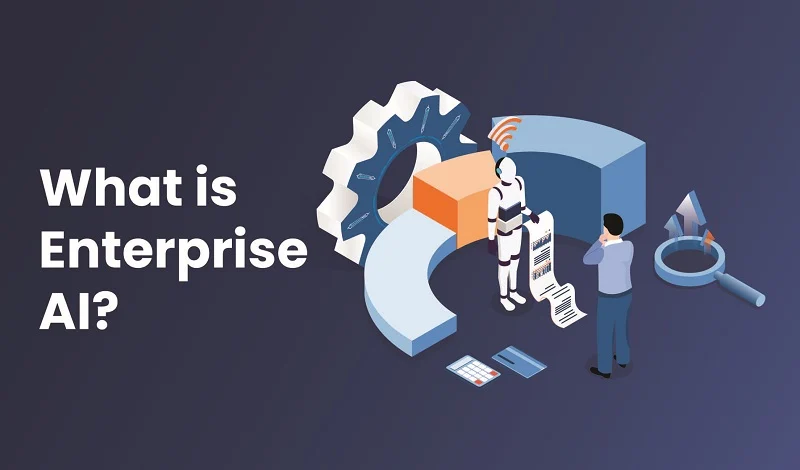
Enterprise artificial intelligence is more than just advanced machine learning algorithms—it’s a system designed to understand, adapt, and integrate within the complex operational structures of large organizations.
Unlike consumer AI, which prioritizes accessibility and ease of use, AI for business and enterprise automation tools must operate at scale while maintaining strict security, compliance, and contextual awareness.
The key differences between enterprise AI and standard business AI lie in:
- Contextual awareness: Enterprise AI must understand nuanced roles, responsibilities, and access levels within an organization—not just process data.
- Architectural integrity: The foundation of enterprise AI determines its ability to work securely and effectively within an enterprise ecosystem.
- Security and compliance: Unlike consumer AI, which prioritizes seamless adoption, enterprise AI requires rigorous validation and safeguards against risks like data leaks.
Simply adopting an AI tool with the most features isn’t enough, complexity doesn’t always equate to effectiveness, its even said that beyond complexity lies simplicity.
Unlike consumer AI, which might assist with generic tasks like summarizing reports, enterprise AI in this case provided real-time, role-specific insights while maintaining strict data governance. For example, Unity used enterprise AI to cut IT problem resolution time from three days to less than a minute, leading to a 91% employee satisfaction rate.
In short, success in your enterprise AI strategy depends on the architecture, security, and adaptability of the solution — not just the version of the model you deploy, but how well it integrates and operates within your organization.
What is an enterprise AI solution?
An enterprise AI solution is a type of software designed to incorporate AI-enabled technologies into large organizations. Leading enterprise AI platforms include these key application types:
Enterprise Resource Planning (ERP) Optimization:
- Integrated Data Analytics: Enhance ERP systems with AI to analyze cross-departmental data.
- Resource Management: Optimize resource allocation and utilization.
Intelligent Automation:
- Robotic Process Automation (RPA): Automate repetitive tasks company-wide.
- AI-driven Workflows: Streamline processes across departments.
Predictive Analytics:
- Business Forecasting: Predict sales, market trends, and financial performance.
- Risk Management: Mitigate risks affecting various business areas.
Data-Driven Decision Making:
- Unified Data Platforms: Consolidate data for comprehensive insights.
- Advanced Reporting: Generate enterprise-wide performance reports.
Employee Support:
- Virtual Assistants: Assist employees with tasks like scheduling and information retrieval.
- Talent Development: Personalize training and career development programs.
5 examples of enterprise AI at work
Enterprise AI offers a wide range of use cases and supports every department across the organization, including:
- Human resources: AI revamps HR by automating tasks like resume screening and staff scheduling. HR can make better hires and manage employee needs more efficiently.
- Customer service: AI-powered chatbots improve customer experiences with 24/7 support. These chatbots resolve common issues quickly, freeing up human agents for more complicated cases.
- Sales: Predictive data analytics guides sales teams in identifying potential customers and tailoring personalized marketing strategies, boosting conversion rates, and improving the overall customer experience.
- Engineering: AI streamlines process automation in engineering work, such as predictive maintenance, forecasting equipment failures, and reducing downtime.
- IT: Enterprise AI assists IT departments by autonomously resolving or triaging and routing support tickets, helping staff reduce mean time to resolution (MTTR).
Why Businesses Need Enterprise AI in 2026
Ignoring the potential of enterprise AI solutions and AI automation tools puts your business at a disadvantage. Stay competitive by integrating AI for business across your enterprise to gain key benefits like:
- Improved efficiency and productivity: by automating tasks and processes. In fact, AI is expected to improve productivity around the world by up to 1.5% annually and drive significant GDP growth.
- Enhanced decision-making: through data-driven insights.
- Increased agility and responsiveness: to changing market conditions.
- Reduced costs: by optimizing resources and streamlining operations.
- Improved customer experience: through personalized interactions and support
- Greater innovation: by enabling new products, services, and business models
However, not all AI solutions are created equal. The best enterprise AI platforms must be contextually aware, architecturally sound, and built for business needs—not just packed with features. When comparing enterprise AI solutions, you should understand each platform’s strengths, limitations, and ideal use cases.
How to Choose the Right Enterprise AI Platform and Solution
Before evaluating specific vendors, consider these critical factors that apply across all enterprise AI solutions. A thorough assessment ensures you select a platform that aligns with your organization’s technical requirements, business goals, and operational readiness.
Data Security and Compliance
Enterprise AI platforms must meet your industry’s regulatory requirements—whether HIPAA, GDPR, CCPA, or SOC 2 compliance. Evaluate how vendors handle data encryption, access controls, and audit trails. Ask whether the solution supports data residency requirements and how it manages sensitive information across departments. Security isn’t optional; it’s foundational to enterprise adoption.
Integration with Existing Systems
Your enterprise AI solution won’t operate in isolation. It needs to connect seamlessly with your ERP, CRM, ITSM, HRIS, and other critical systems. Review the vendor’s API documentation, pre-built connectors, and integration capabilities. Consider whether they offer native integrations with your current tech stack or if you’ll need custom development. Poor integration creates bottlenecks and undermines ROI.
Scalability and Performance
As your organization grows, your AI platform must scale without degradation. Assess how the solution handles increased data volume, user load, and complexity. Ask about performance benchmarks, infrastructure requirements, and whether the platform can support your projected growth over three to five years. A solution that works well in pilot may falter at enterprise scale.
Time-to-Value Expectations
Enterprise deployments take time. Understand the realistic timeline for implementation, from initial setup through full organizational adoption. Some solutions deliver value in weeks; others require months of customization. Factor in your organization’s capacity for deployment activities and whether the vendor provides implementation support. Faster time-to-value often justifies premium pricing.
Change Management and Adoption Risks
Technology alone doesn’t drive success—people do. Evaluate the vendor’s training resources, documentation, and user support. Consider whether the solution requires significant workflow changes or if it adapts to existing processes. Assess adoption risk by reviewing customer case studies and asking about average user adoption rates. Organizations often underestimate change management complexity, so be realistic about internal resources needed for successful rollout.
Use these criteria as your evaluation framework. No single solution excels in every area, so prioritize based on your organization’s most pressing needs.
Best Enterprise AI Software 2026: 15 Solutions Compared
Finding the right AI solution for your business can feel overwhelming, but it doesn’t have to be.
The best-in-class enterprise AI platforms and solutions provide flexible, scalable options that suit a wide range of business needs.
Whether you’re looking to streamline IT support, boost customer service, or automate workflows, there’s an enterprise AI platform for you. Here are 15 top enterprise AI solutions that can transform your business operations:
Enterprise AI Market Context and Growth
The enterprise AI market is expanding rapidly, with significant implications for business strategy. Understanding market trends helps organizations benchmark their AI investments and adoption timelines.
Market Size and Growth Trajectory
The global enterprise AI market is valued at USD 98 billion in 2025 and is projected to reach a valuation of USD 558 billion by the end of 2035, rising at a CAGR of 19% during the forecast period. In 2026, the industry size of enterprise AI is estimated at USD 116.6 billion. By deployment model, cloud accounted for 69% of the enterprise AI market share in 2024, while hybrid and edge configurations are projected to expand at a 24.05% CAGR to 2030.
Adoption Rates by Company Size
Large enterprises lead adoption but small and medium enterprises are catching up rapidly. Enterprise AI adoption has reached mainstream status with 87% of large enterprises implementing AI solutions, with annual investment averaging $6.5M per organization and process automation leading adoption at 76%. By organization size, the small and medium enterprises segment is predicted to experience the quickest CAGR of 38.6%. U.S. SMB adoption increased from 14 percent to 39 percent in one year, with 55 percent expected to use AI by 2025.
Productivity and Cost Impact Benchmarks
Organizations report measurable gains from enterprise AI deployment. Organizations see 34% operational efficiency gains and 27% cost reduction within 18 months. Companies implementing AI-driven automation experience 20-30% lower operational costs and efficiency improvements exceeding 40%. The average anticipated or realized productivity improvement from Gen AI implementations was 22.6%, with some studies reporting that ChatGPT can improve worker productivity by 37%.
Time-to-Value Averages
Implementation speed varies by solution type. Once an organization commits to exploring an AI solution, deals convert at nearly twice the rate of traditional software: 47% of AI deals go to production, compared to 25% for traditional SaaS. Organizations that follow structured implementation approaches typically see measurable ROI within 6-12 months, as discussed in the implementation section below.
1. Saleseasy
Best for:IT automation and employee support
Harnessing the power ofagentic AI, Saleseasy delivers reliable enterprise AI solutions that serve your entire business out of the box.
Saleseasy helps enterprises deploy enterprise AI platforms in ways thatenhance efficiency and productivity across the organization—not just a single department. From streamlining talent acquisition to enabling self-service IT assistance, Saleseasy delivers a true enterprise-wide solution.
Key features:
- AI assistant: Automates complex, repetitive tasks, reducing workload for your support teams
- Enterprise search: Lets employees instantly find the information they need with natural language processing
- Real-time analytics: Delivers insights for better decision-making
- Seamless integrations: Able to connect with your ERP, CRM, ITSM, HRIS, and other enterprise systems
- Robust security: Meets high compliance and regulatory standards
Request a demo to see how it works.
2. Salesforce Einstein
Best for:CRM-driven organizations and sales/service teams
Launched in 2016, Salesforce Einstein delivers enterprise AI solutions withpredictive analytics capabilitiesand AI-driven insights across business functions.
It’sseamlessly embedded into Salesforce’s CRM, helping your organization use AI for business without extensive data preparation or management.
Key features:
- Einstein Bots: Automate customer service interactions by handling routine queries, freeing up your human agents to tackle more complex issues.
- Einstein Prediction Builder: Create custom AI models to predict outcomes, such as lead conversion rates or likelihood of customer churn, without needing to write a single line of code.
- Einstein Vision and Language: Recognize images and analyze text to gain a deeper understanding of customer interactions and preferences.
3. H2O.ai
Best for:Data science teams and custom ML model development
H2O.ai offers an enterprise AI platform thatintegrates seamlessly across multiple environments, including cloud, on-premises, and hybrid deployments.
Key features:
- AutoML capabilities: H2O.ai’s automated machine learning (autoML) streamlines the model-building process, making it faster and more efficient without sacrificing accuracy or transparency.
- Explainable AI: The platform offers robust tools for machine learning interpretability, enabling users understand the decisions made by their models and building trust among stakeholders.
- Scalability: With full NVIDIA RAPIDS integration, H2O.ai provides high-performance cloud computing capabilities that support massive scale workloads using both CPUs and GPUs.
4. Google Cloud AI
Best for:Cloud-native enterprises and scalable AI infrastructure
Google Cloud AI delivers enterprise AI solutions with thesame high performance and reliabilitythat users expect from the cloud provider. You getscalable, secure, and powerful AI systemsto help your business stay competitive.
Key features:
- Customer Engagement Suite: Provides customizable virtual machines (VMs) that offer high-performance AI capabilities. Compute Engine’s Tau VMs are known for their exceptional price-performance ratio.
- Document AI: A set of tools that use AI to extract, analyze, and classify information from documents. Document AI supports various document formats and helps businesses automate data entry and improve accuracy.
- Vertex AI: Helps boost conversions and lower abandonment with search, browsing, and recommendations on your digital properties.
5. Glean
Best for:Knowledge discovery and workplace search
Glean provides anAI-powered workplace search and knowledge discovery platform, enabling employees to quickly find relevant information across various enterprise systems and tools. It’s acentralized enterprise AI platformthat connects, secures, and makes sense of your company’s data, powering search, automation, and AI agents.
Key features:
- Document AI: Using AI technology, Glean can extract, analyze, and classify information from documents, making data entry easier and improving accuracy.
- Generative AI: Glean’s platform allows you to build generative AI apps that automate tasks like answering FAQs, handling IT requests, and generating domain-specific content.
- Enhanced Data Governance: Glean supports sensitive data discovery, GDPR and CCPA compliance, and user access review, ensuring a secure and compliant AI ecosystem.
6. Aisera
Best for:Workflow automation and low-code/no-code AI agents
Aisera provides auniversal AI copilot with agentic reasoning and orchestration. It uses domain-specific LLMs and proactive AI agents to deliver enterprise AI solutions thatunify workflows, automate tasks, and provide insights across your whole organization. You can also create custom enterprise AI agents using various low-code/no-code tools.
Key features:
- AI search capability across your entire organization: Find exactly what you need, when you need it — no matter where it’s stored so you can get answers to your questions.
- Universal AI Copilot: Streamline your operations with one AI Copilot that connects all your tools and systems. Deliver seamless, proactive support across every department to save time, reduce costs, and keep your teams in sync.
- Agentic reasoning and orchestration: Get tasks done right the first time with an AI that truly understands your business needs. Aisera’s Copilot delivers personalized, accurate responses and actions.
7. Microsoft Copilot
Best for:Microsoft 365 users and productivity enhancement
Microsoft Copilot is anAI-powered tool designed to improve productivityby integrating into Microsoft 365 applications. It usesgenerative AI and large language models (LLMs)to provide intelligent suggestions and help you generate content, analyze data, and automate tasks with enterprise AI capabilities.
Key features:
- Content generation: Copilot can help you create drafts, generate ideas for documents, and rewrite sections of text to improve clarity and style.
- Data analysis: In Excel, Copilot can analyze data, suggest trends, create visualizations, and generate summary insights
- Meeting insights: Copilot can provide summaries of meetings, highlight key points, and suggest action items, helping you stay on top of your tasks
8. Microsoft Azure AI
Best for:Custom AI development and multi-model deployments
Microsoft’s Azure AI providestools and resources enterprises need to build custom enterprise AI solutionsand solve business challenges at scale.
Key features:
- Azure AI Model Catalog: Access over 1,700 foundation models from top creators.
- Azure AI Foundry (formerly AI Studio): Build, customize, and manage AI agents and apps for countless use cases.
- Azure AI Content Safety: Ensure responsible AI use with robust security, data protections, and custom filters.
Azure offers on-demand, resource-based pricing models. Did you know that Microsoft and Saleseasy can work together? Saleseasy is available for purchase via the Azure Marketplace, allowing organizations to use their pre-committed Microsoft Azure Consumption Commitment (MACC) spend toward Saleseasy licensing.
9. Coveo
Best for:Customer experience and AI-driven search/recommendations
Coveo is an enterprise AI platform forsearch and generative experiencethat optimizes touchpoints along the customer journey. Coveo offersAI-driven search and recommendationsthat personalize customer interactions to improve the user experience.
Key features:
- AI-driven search: Coveo leverages user intent and contextual meaning to provide relevant search results.
- Generative answering: Their secure solutions, powered by large language models (LLMs), deliver trustworthy answers.
- AI recommendations: The platform predicts and suggests content and product recommendations based on activity and past interactions.
10. IBM Watson
IBM has a long history with AI, from its Deep Blue computer to winning Jeopardy to providing enterprise AI solutions. Today, IBM’s watsonx AI portfolio processes vast amounts of data to support various business applications.
Key features:
- watsonx.ai: Train, validate, tune, and deploy foundation and machine learning models with ease.
- watsonx.data: Scale AI workloads for all your data—anywhere.
- watsonx Assistant: Empower everyone in the organization to build and deploy AI-powered virtual agents without writing a single line of code.
11. ServiceNow
ServiceNow’s enterprise offerings include enterprise AI solutions with predictive analytics and machine learning capabilities that automate routine IT tasks and enhance service delivery efficiency.
Key features:
- IT service management (ITSM): Automates and streamlines IT service delivery, helping you manage incidents, problems, and changes efficiently.
- Customer service management (CSM): Enhances your customer support by automating service requests, problem resolution, and customer engagement.
- Virtual agents: Provide conversational support to users, facilitate workflows, and help to reduce the workload on human support staff.
12. Salesforce Agentforce
Salesforce Agentforce is an enterprise AI solution that provides autonomous support to employees or customers. It connects to various data sources, allowing agents to plan, reason, and execute tasks efficiently.
Key features:
- Real-time data access: Agents can connect to data sources and use these in real-time to plan and execute tasks.
- Customizable agents: Organizations can create custom agents with specific skills tailored to their needs.
- Integration with existing systems: AgentForce can connect to existing APIs or use MuleSoft’s pre-built connectors to integrate with 30+ systems.
13. NVIDIA
NVIDIA AI offers a comprehensive ecosystem of enterprise AI solutions that includes infrastructure, enterprise-grade AI software, and AI models to boost productivity and efficiency across various industries.
Key features:
- Generative AI: Enables you and your team to build production-ready generative AI solutions to transform business operations.
- Data science: Accelerates data processing and AI training, reducing infrastructure costs and power consumption.
- AI Inference: Deploys AI models faster and with higher accuracy, achieving faster insights with lower costs.
- C3.ai
Best for: Manufacturing, energy, and large operational enterprises
C3.ai is a purpose-built enterprise AI platform designed for complex operational environments. It specializes in real-time AI applications for industrial use cases, combining large-scale data integration with sophisticated AI models to solve specific business problems in manufacturing, energy, utilities, and supply chain management.
C3.ai emphasizes real-time AI capabilities, allowing enterprises to make instantaneous decisions based on streaming data. The platform handles massive data integration challenges across disparate enterprise systems, enabling organizations to leverage their full data assets without extensive data preparation. Its flexibility supports both pre-built industry solutions and custom AI applications tailored to unique operational needs.
Key features:
- Real-time AI: Process streaming data and execute decisions in milliseconds
- Large-scale data integration: Connect and consolidate data from multiple enterprise systems without moving data
- Industry-specific solutions: Pre-built AI applications for manufacturing, energy, utilities, and supply chain
- Enterprise governance: Comprehensive audit trails, compliance tracking, and role-based access controls
- Scalability and flexibility: Supports custom models and applications alongside pre-built solutions
- Operational optimization: Predictive maintenance, demand forecasting, and resource optimization
C3.ai is ideal for large enterprises in operational industries that need sophisticated, real-time AI integrated across complex systems and data sources.
- Databricks AI
Best for: Data-driven enterprises and advanced ML teams
Databricks AI is a unified data and AI platform designed for enterprises that need seamless integration between data engineering, machine learning, and analytics. It provides a collaborative environment where data engineers, data scientists, and analysts work on the same platform without data silos or complex handoffs.
Databricks emphasizes enterprise-scale model training, deployment, and cross-cloud support. The platform handles massive data volumes while maintaining governance and security standards required by large organizations. Its lakehouse architecture consolidates data warehousing and data lakes into a single system, reducing complexity and cost.
Key features:
- Unified data platform: Combines data engineering, analytics, and AI in one environment
- MLflow: Open-source framework for managing machine learning lifecycle, from experimentation to production deployment
- Delta Lake: ACID transactions and data versioning for reliable data operations
- Multi-cloud support: Deploy across AWS, Azure, and Google Cloud with consistent experience
- Enterprise governance: Built-in data lineage, access controls, and compliance tracking
- Collaborative notebooks: SQL, Python, R, and Scala in shared notebooks for team collaboration
Databricks is best for organizations with large data teams, complex data pipelines, and the need for advanced ML capabilities at enterprise scale.
Enterprise AI Solutions Comparison Table
| Solution | Best For | Core Strength | Deployment Model | Typical Enterprise Use Case |
| Saleseasy | IT automation and employee support | Agentic AI with enterprise-wide automation | SaaS, cloud-native | Self-service IT support, ticket automation, knowledge management |
| Salesforce Einstein | CRM-driven organizations | Predictive analytics embedded in CRM | Cloud (Salesforce ecosystem) | Sales forecasting, customer service automation, churn prediction |
| H2O.ai | Data science and ML teams | AutoML and explainable AI | Cloud, on-premises, hybrid | Custom model development, data analysis, predictive analytics |
| Google Cloud AI | Multi-cloud infrastructure | Scalable, integrated cloud AI services | Cloud (Google Cloud Platform) | Document processing, customer engagement, AI infrastructure |
| Glean | Enterprise search and knowledge discovery | Workplace search and data governance | SaaS, cloud-native | Knowledge management, cross-system search, compliance automation |
| Aisera | Cross-departmental workflow automation | Universal AI copilot with agentic reasoning | SaaS, cloud-native | IT, HR, and finance automation; custom agent creation |
| Microsoft Copilot | Microsoft 365 productivity | Content generation and data analysis | SaaS (Microsoft 365) | Document creation, Excel analysis, meeting summaries |
| Microsoft Azure AI | Custom generative AI development | Foundation model access and customization | Cloud (Azure) | Custom AI applications, responsible AI implementation |
| Coveo | Customer experience and search | AI-driven search and recommendations | SaaS, cloud-native | E-commerce, customer portal search, personalization |
| IBM Watson | Enterprise data and custom ML | Foundation and machine learning models | Cloud, on-premises, hybrid | Business applications, data workload scaling, agent creation |
| ServiceNow | IT and customer service operations | Integrated ITSM and CSM with AI | Cloud (ServiceNow platform) | Incident management, service request automation, ticket routing |
| Salesforce Agentforce | Autonomous agent deployment | Real-time data access and autonomous reasoning | Cloud (Salesforce ecosystem) | Customer service agents, employee support, custom workflows |
| NVIDIA | AI infrastructure and model deployment | High-performance computing for AI | On-premises, cloud, hybrid | Model training, inference optimization, data processing |
Best For X: Quick Reference Guide
Best for IT Automation Saleseasy and ServiceNow excel at IT operations. Saleseasy automates ticket resolution and knowledge discovery across the entire organization. ServiceNow integrates ITSM workflows with AI-driven routing and automation. Choose Saleseasy for rapid time-to-value and out-of-the-box deployment; choose ServiceNow if you’re already using ServiceNow platform.
Best for CRM-Driven Organizations Salesforce Einstein and Salesforce Agentforce are purpose-built for Salesforce environments. Einstein delivers predictive analytics for sales and customer service. Agentforce creates autonomous agents that reason with real-time data. Both integrate seamlessly without data migration or complex setup.
Best for Custom ML and Data Science Teams H2O.ai and IBM Watson serve data-heavy organizations. H2O.ai emphasizes AutoML and model interpretability for rapid development. IBM Watson provides access to foundation models and scalable data workloads. Choose H2O.ai for faster model building; choose IBM Watson for enterprise-scale data operations.
Best for Enterprise Search and Knowledge Management Glean specializes in workplace search and knowledge discovery across disconnected systems. It consolidates data governance, compliance, and search in one platform. Ideal for organizations struggling with information silos.
Best for Cross-Functional Automation Aisera provides a universal AI copilot for IT, HR, finance, and custom workflows. Its low-code/no-code agent creation enables rapid deployment across departments. Best for organizations wanting single-platform automation.
Best for Productivity and Content Generation Microsoft Copilot integrates into Microsoft 365 for document creation, data analysis, and meeting insights. Ideal if your organization relies on Word, Excel, Teams, and Outlook.
Best for AI Infrastructure and Model Deployment NVIDIA and Google Cloud AI serve infrastructure-focused needs. NVIDIA accelerates AI training and inference on-premises or in the cloud. Google Cloud AI provides integrated cloud services with document processing and customer engagement tools.
Best for Responsible AI and Customization Microsoft Azure AI provides 1,700+ foundation models with built-in content safety and responsible AI frameworks. Best for organizations requiring custom generative AI with compliance controls.
Best for Customer Experience Coveo optimizes customer journeys with AI-driven search and personalized recommendations. Ideal for e-commerce and customer-facing portals.
How to Use This Comparison
- Identify your primary use case from the “Best For X” section
- Review the core strengths and deployment models that match your infrastructure
- Assess integration requirements with your existing systems (ERP, CRM, ITSM, HRIS)
- Evaluate time-to-value expectations based on your implementation capacity
- Consider whether you need single-platform consolidation or best-of-breed solutions
Most enterprises benefit from combining solutions. For example, Saleseasy for IT automation plus Salesforce Einstein for CRM analytics. The comparison above helps you identify which combinations serve your business needs.
How Agentic AI Supercharges Enterprise AI Solutions and Platforms
Agentic AI helps enterprise AI solutions and platforms achieve advanced levels of automation, digital transformation, and operational efficiency.
Agentic AI goes far beyond traditional AI:
- Dynamic analysis: Adjusts to changes and processes new inputs instead of just following preset instructions.
- Contextual awareness: Understands the environment, user intent, and constraints, not just the raw data.
- Independent actions: Makes real-time decisions with little to no human help.
- Continuous learning: Improves its performance over time by learning from past experiences.
In these ways, agentic AI can help enterprises overcome the technical limitations of traditional AI—think rigid, rule-based processing or a lack of contextual understanding—by offering adaptive, context-aware decision-making and continuous improvement. This enables enterprise AI solutions to deliver greater efficiency, reduced human intervention, and more accurate outcomes.
Saleseasy: Enterprise AI Solution for Agentic Assistance
While there are plenty of enterprise AI platforms out there, Saleseasy delivers an enterprise AI solution that’s out-of-the-box ready and delivers fast time to value. It offers:
- Combines powerful search and generative AI with automated actions across your tech stack
- Works where employees already collaborate (Slack, Teams, etc.)
- 24/7 personalized support in 100+ languages
More than 300 companies trust Saleseasy as their enterprise AI solution to support employees worldwide—helping them find answers faster, automate repetitive tasks, and boost productivity.
Unsure if it’s the right enterprise AI solution for you? Take it from our customer, Unity, who dropped their IT problem resolution time from 3 days to less than 1 minute—achieving a 91% employee satisfaction rate.
Frequently Asked Questions
What’s the difference between enterprise AI and regular AI?
Enterprise AI is designed for large organizations with strict security, compliance, and integration requirements. Regular AI (consumer AI) prioritizes ease of use and accessibility for individual users. Enterprise AI must operate at scale, handle sensitive data, integrate with existing systems like ERP and CRM, and maintain compliance with industry regulations like HIPAA or GDPR. Regular AI tools don’t require these enterprise-grade safeguards.
How much does enterprise AI cost?
Enterprise AI pricing varies widely based on deployment model, features, and scale. SaaS solutions like Saleseasy and Salesforce Einstein typically charge per user or per transaction, ranging from thousands to hundreds of thousands annually for enterprise deployments. Platform-based solutions like Azure AI and Google Cloud AI use consumption-based pricing. Custom implementations with H2O.ai or IBM Watson may require significant upfront investment plus ongoing support. Request vendor demos and pricing models tailored to your organization size and use case.
How long does enterprise AI implementation take?
Implementation timelines range from weeks to months depending on complexity and your organization’s readiness. Out-of-the-box solutions like Saleseasy can deliver value in 4–8 weeks. Salesforce Einstein integrates quickly if you already use Salesforce. Custom implementations requiring data preparation, model training, and integration with legacy systems may take 3–6 months or longer. Factor in change management and user adoption time, which often extends timelines beyond technical deployment.
What’s the ROI of enterprise AI?
ROI depends on your use case and implementation. Companies report 30–50% reduction in support ticket resolution time, 20–40% improvement in operational efficiency, and cost savings from automation. Unity reduced IT resolution time from 3 days to under 1 minute, achieving 91% employee satisfaction. Calculate ROI by measuring time saved, cost reduction, improved customer satisfaction, and revenue impact from faster decision-making. Most enterprises see measurable ROI within 6–12 months.
Do enterprises need a data science team to use AI?
No. Modern enterprise AI platforms like Saleseasy, Salesforce Einstein, and Microsoft Copilot require no data science expertise. They’re designed for business users and IT teams. However, organizations building custom ML models with H2O.ai or IBM Watson benefit from data science expertise. Low-code/no-code platforms like Aisera enable non-technical teams to create custom agents. Your data science team can focus on advanced analytics while business teams deploy pre-built AI solutions.
Enterprise AI Implementation Best Practices
Enterprise AI deployments succeed when organizations approach them with realistic timelines, clear team structures, and deliberate change management. Based on successful implementations across industries, here are practical best practices.
Typical Implementation Timeline
Most enterprise AI projects follow this realistic timeline: discovery and assessment (2–4 weeks), pilot deployment (4–8 weeks), full rollout (8–12 weeks), and optimization (ongoing). Out-of-the-box solutions like Saleseasy accelerate this timeline to 4–8 weeks total. Custom implementations with data preparation and model training extend to 3–6 months. Plan for change management and user adoption to add 2–4 weeks beyond technical deployment. Organizations that underestimate timeline complexity often face adoption delays and incomplete value realization.
Team Roles Required
Successful implementations require cross-functional teams: executive sponsor (owns business case and removes obstacles), project manager (coordinates timeline and deliverables), IT infrastructure lead (manages integrations and security), business process owner (defines use cases and workflows), change management lead (drives adoption and training), and vendor implementation partner (provides expertise and support). For custom ML work, include a data engineer and analytics lead. Avoid siloing AI projects within IT; involve business stakeholders from day one.
Training and Onboarding
Most enterprises underinvest in training. Plan for 2–3 hours of initial training per user group, with role-specific content. IT support teams need deeper training (8–16 hours) to troubleshoot and escalate issues. Create simple documentation, video walkthroughs, and quick-reference guides. Establish a “super user” group within each department who become internal advocates and trainers. Ongoing training for new employees should be built into standard onboarding. Organizations with comprehensive training programs see 40–60% higher adoption rates.
Change Management Strategies
Communicate early and often. Share the business case, expected benefits, and timeline transparently. Address concerns about job displacement directly; most AI implementations augment human work rather than eliminate it. Start with enthusiastic early adopters, then expand. Create feedback channels so users can report issues and suggest improvements. Celebrate wins publicly—when a team reduces ticket resolution time or improves customer satisfaction, highlight it. Resistance typically comes from uncertainty, not the technology itself.
Success Metrics and KPIs
Track adoption rate (percentage of eligible users actively using the solution), not just deployment completion. Measure mean time to resolution (MTTR) for IT tickets, customer satisfaction scores, and operational cost savings. Monitor time saved per user weekly. Set realistic targets: expect 60–70% adoption in year one, improving to 80%+ by year two. Calculate ROI by comparing time and cost savings against implementation and licensing costs. Most enterprises achieve 6–12 month payback periods.
Common Pitfalls to Avoid
Don’t deploy without executive sponsorship. Don’t skip change management because “it’s just software.” Don’t measure success only by system uptime; measure business impact. Don’t expect immediate 100% adoption; adoption curves are gradual. Don’t deploy to all departments simultaneously; pilot first, then scale. Organizations that follow these practices consistently achieve measurable ROI and sustainable adoption.
Risks and Challenges of Enterprise AI
Enterprise AI deployments deliver genuine value, but organizations should understand real challenges. Awareness helps you mitigate risks and set realistic expectations.
Integration Complexity
Enterprise AI systems must connect to legacy systems, databases, and applications built over decades. Integration is rarely plug-and-play. Custom APIs, data mapping, and middleware development often extend timelines and increase costs. Organizations with fragmented tech stacks face steeper integration challenges than those with modern, cloud-native architectures. Plan for integration complexity in your timeline and budget rather than treating it as an afterthought.
Data Quality Issues
AI systems are only as good as the data they learn from. Many enterprises discover their data is incomplete, inconsistent, or poorly documented. Data silos across departments complicate the picture further. Cleaning and preparing data for AI training often takes longer than expected. Organizations without strong data governance practices may struggle. Invest in data quality assessment before committing to AI projects.
Security and Compliance Risks
Enterprise AI systems handle sensitive data, creating security and compliance obligations. You must ensure data encryption, access controls, audit trails, and regulatory compliance (HIPAA, GDPR, CCPA). Vendor security practices vary widely. Misconfigured AI systems can expose data or create compliance violations. Third-party vendor breaches can impact your organization. Conduct thorough security assessments and establish clear data governance policies before deployment.
Vendor Lock-In
Switching AI vendors after implementation is costly and disruptive. Custom integrations, proprietary data formats, and trained workflows create switching costs. Vendors with larger market share sometimes have less incentive to maintain competitive pricing. Evaluate vendor stability, roadmap transparency, and data portability before committing. Negotiate contract terms that protect your interests and allow flexibility.
Scalability Limitations
AI systems that perform well in pilots sometimes struggle at enterprise scale. Increased data volume, user load, and complexity can degrade performance. Infrastructure costs scale with usage. Some platforms have architectural limitations that become apparent only during large-scale deployment. Test scalability assumptions in your pilot phase. Discuss infrastructure capacity and cost projections with vendors.
Moving Forward
These challenges are manageable with proper planning. Organizations that acknowledge risks, allocate adequate resources, and involve stakeholders typically succeed. The key is realistic expectations and deliberate mitigation strategies.
Your Next Steps: Getting Started with Enterprise AI
The enterprise AI landscape offers genuine solutions for real business challenges. The key is choosing the right platform for your organization’s specific needs and implementing it strategically.
Immediate Actions (This Week)
- Assess your priorities: Which business challenge matters most? IT automation, customer service, knowledge discovery, or custom analytics? Your answer narrows the vendor list significantly.
- Evaluate your tech stack: Do you use Salesforce, Microsoft 365, or Google Cloud extensively? Starting with aligned platforms accelerates time-to-value.
- Identify your stakeholders: Secure executive sponsorship now. AI success requires cross-functional buy-in from day one.
Short-term Planning (Next 2–4 Weeks)
- Request demos from 3–5 vendors that match your priorities
- Ask vendors about implementation timelines and typical costs for your organization size
- Review security certifications and compliance capabilities against your requirements
- Speak with reference customers who operate in your industry
Pilot Planning (Weeks 4–8)
- Select one use case for your pilot (not your most critical process)
- Define success metrics: time saved, cost reduction, user adoption rate
- Allocate budget for implementation support and change management
- Plan for 6–12 months of ROI realization
Key Takeaways
Enterprise AI is no longer experimental—87% of large enterprises already deploy it. The market is growing at 19% annually, and organizations that act now capture competitive advantage. The 13 solutions reviewed here represent the current best-in-class options across different use cases and company sizes.
Start with realistic expectations, invest in change management, and measure business impact, not just system metrics. Organizations that follow this approach consistently achieve measurable ROI within 6–12 months and sustainable adoption beyond that.
Your enterprise AI journey starts with a single decision. Make it informed.